
Serving Contractors, Builders, and Construction Businesses in Oakville, Halton Region, Burlington, Milton, Hamilton, Toronto & More
Construction businesses work in active job sites where property damage, injuries, tool theft, contract requirements, and project delays can create serious financial risk. Whether you are a general contractor, builder, subcontractor, or small trade business, the right construction insurance helps protect your work, your clients, and your ability to take on new jobs.
Construction insurance in Oakville can include commercial general liability, tools and equipment coverage, commercial auto, builder’s risk insurance, installation floater, professional liability, and project insurance depending on the work being performed.
James Inwood helps Oakville contractors and construction businesses arrange insurance that fits their trade, project requirements, certificates, tools, vehicles, and contract obligations.

Quick Glance: Construction Insurance in Ontario
- Construction insurance is designed for contractors, builders, subcontractors, renovation companies, and construction businesses.
- It often starts with commercial general liability insurance, which helps protect against third-party bodily injury and property damage claims.
- Many clients, builders, condo boards, municipalities, and property managers ask for a construction insurance certificate before work begins.
- Construction insurance for contractors may also include tools, equipment, commercial auto, installation floater, builder’s risk, professional liability, and pollution liability.
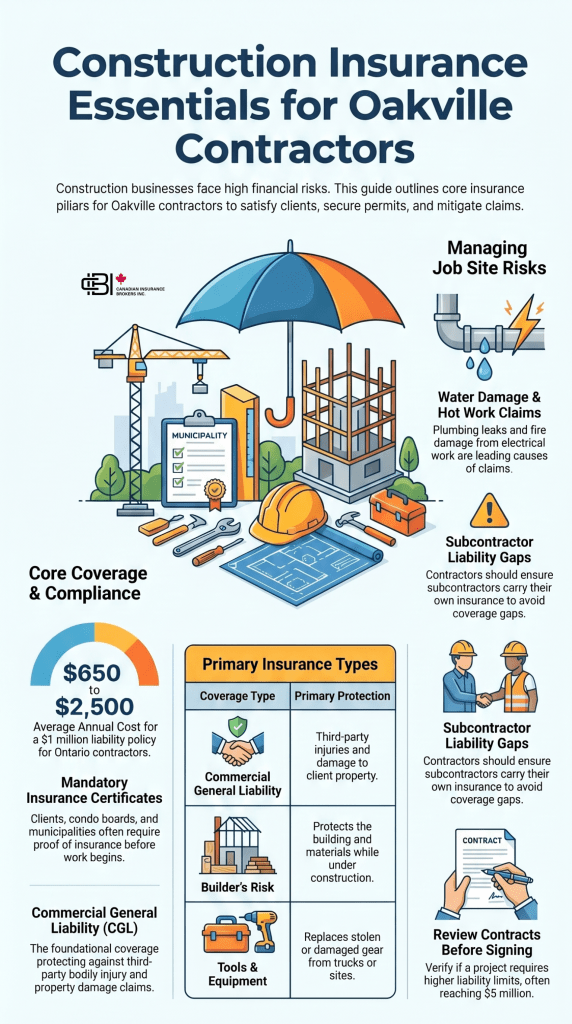
- Many Oakville contractors pay around $650 to $2,500 per year for a $1 million liability policy, depending on the trade, revenue, claims history, and type of work.
- Course of construction insurance and builder’s risk insurance are used to protect a construction project while work is underway.
- Oakville contractors may need proof of insurance for licensing, permits, condo work, municipal contracts, commercial leases, or general contractor approval.
What Is Construction Insurance and Why Does It Matter?
Construction insurance is a group of liability and property coverages designed for businesses that build, repair, renovate, install, demolish, or manage construction work.
The core coverage is usually commercial general liability insurance. It helps respond when a third party claims your business caused bodily injury or property damage. This can include damage to a client’s home, injury at a job site, or damage to neighbouring property.
Construction work also involves tools, vehicles, materials, subcontractors, and changing job sites. That is why many contractors need more than basic liability coverage. The right policy setup depends on the trade, project size, contract wording, and whether you are working as a subcontractor, general contractor, builder, or project manager.
Because construction work is often contract-driven, insurance is commonly required before work begins. A certificate of insurance helps confirm that coverage is active and that the contractor meets the required limits.
Who Construction Insurance Is For
Construction insurance can apply to many trades and business types, including:
- General contractors
- Home builders
- Renovation contractors
- Subcontractors
- Plumbers
- Electricians
- HVAC contractors
- Roofers
- Carpenters
- Framers
- Drywall contractors
- Painters
- Flooring installers
- Concrete contractors & masons
- Excavation contractors
- Landscapers
- Handymen
- Project managers
- Design-build firms
Coverage applies whether services are provided as a sole proprietor, incorporated contractor, small crew, subcontractor, or growing construction company.
Types of Construction Businesses This Insurance Covers
Construction insurance can be structured for the different business setups commonly used by contractors and builders in Ontario.
Independent Contractors
Common for solo trades and small operators. These contractors may be personally named in contracts and may need their own liability policy, tools coverage, and certificate of insurance.
Sole Proprietorships
A single owner operating under a registered business name. Since there is no legal separation between the owner and the business, liability insurance is important for protecting income and personal assets.
Incorporated Contractors
Common for builders, renovation firms, trade businesses, and contractors with crews. Clients often require insurance to be issued in the company’s legal name, with certificates matching the contract.
Subcontractors
Subcontractors are often asked to provide their own certificate of insurance before entering a job site. They should not assume the general contractor’s insurance fully protects them.
Builders and Project Owners
Builders may need annual contractor insurance as well as project coverage such as builder’s risk insurance, course of construction insurance, or wrap-up liability.
Contractors Using Subcontractors
General contractors and renovation companies often rely on subcontractors. Insurance should address subcontractor work, certificates, contractual requirements, and whether subcontractors carry their own coverage.
What Clients and Contracts Commonly Require
Construction contracts often require commercial general liability insurance with $2 million or $5 million limits, depending on the project. The contract may also require a certificate of insurance, additional insured wording, commercial auto, builder’s risk, installation floater, wrap-up liability, or pollution liability.
Common certificate requests come from:
- Homeowners
- General contractors
- Builders
- Commercial landlords
- Condo boards
- Property managers
- Municipalities
- Lenders
- Developers
- Project owners
In Oakville, contractors working in the town are required to have a valid business licence, and the Town notes that licensing includes proof of insurance and security clearances.
For municipal construction work, Town of Oakville insurance requirements can include higher liability limits and other coverage depending on the contract. This is why insurance should be reviewed before a contractor signs an agreement or starts work.

Core Insurance Coverages for Construction Professionals
- Commercial General Liability: Covers third-party bodily injury and property damage claims arising from construction or contractor operations.
- Tools and Equipment Coverage: Helps protect work tools, equipment, and mobile property from theft or damage, depending on the policy.
- Commercial Auto Insurance: Covers trucks, vans, trailers, and vehicles used for business purposes.
- Installation Floater: Covers materials, fixtures, or equipment while being transported, stored, or installed before the work is complete.
- Builder’s Risk Insurance: Also called course of construction insurance. It protects a building or renovation project while construction is underway.
- Professional Liability: Used when the contractor provides design, consulting, project management, estimating, or technical advice.
- Pollution Liability: May be needed for excavation, demolition, fuel, mould, asbestos, environmental exposure, or work that could create contamination risk.
- Wrap-Up Liability: A project liability policy used on larger construction projects to cover multiple parties involved in the same project.
Where Construction Claims Often Arise
Construction insurance often becomes important after routine job site issues. Water damage, injuries, tool theft, and materials damage can all turn into claims that delay work or create unexpected costs.
Plumbing or Renovation Work
Water escapes into walls, floors, nearby units, or finished areas.
How it becomes a claimA client, neighbour, condo board, or landlord makes a property damage claim.
Roofing or Exterior Work
Rain enters the building while the project is still underway.
How it becomes a claimInterior finishes, insulation, flooring, or client belongings are damaged.
Electrical or Hot Work
Fire, smoke, or heat damage occurs during electrical, welding, or cutting work.
How it becomes a claimThe contractor may face repair costs, liability claims, and legal defence expenses.
Job Site Access
A client, visitor, delivery person, or passerby is injured near the work area.
How it becomes a claimThe injured person may make a bodily injury claim against the contractor.
Tool Storage
Tools are stolen from a truck, trailer, garage, storage unit, or job site.
How it becomes a claimTools and equipment coverage may help replace stolen work property if included.
Materials Awaiting Installation
Windows, flooring, cabinets, fixtures, or other materials are damaged before installation.
How it becomes a claimInstallation floater or project coverage may respond depending on the policy.
Coverage depends on the policy, contract wording, exclusions, deductibles, and who is legally responsible for the damage.
Common Claims for Contractors and Builders
Construction insurance often becomes important after routine job site problems, not only major losses.
Common claims include:
- Water damage during plumbing, roofing, or renovation work
- Fire or smoke damage from electrical work or hot work
- A client, visitor, or passerby injured at a job site
- Damage to flooring, walls, windows, fixtures, or neighbouring property
- Theft of tools from a truck, trailer, garage, or job site
- Materials damaged before installation
- Damage caused by subcontracted work
How insurance helps:
Construction insurance can help pay for legal defence, covered damages, tool replacement, project property damage, and certificate-related requirements depending on the policy.
For example, if a subcontractor working in a kitchen renovation damages a water line and water spreads into the room below, commercial general liability may help respond if the contractor is legally responsible for third-party property damage.
Course of Construction Insurance and Builder’s Risk Insurance
Course of construction insurance and builder’s risk insurance are often used to describe coverage for a building, renovation, or construction project while work is underway.
This coverage may be needed for:
- New home builds
- Major renovations
- Commercial construction
- Additions
- Structural upgrades
- Tenant improvements
- Multi-unit residential projects
- Projects financed by lenders
Unlike contractor liability insurance, builder’s risk coverage is focused on the project itself. Contractor liability insurance is generally designed to respond to third-party injury or property damage claims, while builder’s risk insurance helps protect the building, materials, and construction value from insured physical loss or damage during the build.
Before construction begins, it is important to review the project details carefully. The property address, total construction value, type of work, start date, expected completion date, policy limits, deductibles, and named insureds can all affect how coverage should be arranged.
For more context on the terminology, see our blog to the difference between COC and builders risk.
What Is Construction All Risk Insurance?
Construction all risk insurance, often called CAR insurance, is project insurance used for construction work. It is meant to protect the project against insured physical loss or damage during construction.
The name can be misleading. Construction all risk insurance does not cover every possible issue. It still has exclusions, limits, deductibles, and conditions.
CAR insurance may be used for larger construction projects, commercial builds, infrastructure work, or contracts that require project insurance.
How Much Does Construction Insurance Cost in Oakville?
Construction insurance cost in Oakville depends on the trade, revenue, number of employees, subcontractor use, claims history, project size, vehicles, tools, and required liability limits. For many Oakville contractors, a $1,000,000 commercial general liability policy may cost about $850 to $2,500 per year.
| Coverage Type | Common Cost Factor | Why It Matters |
|---|---|---|
| Commercial general liability | Trade, revenue, payroll, limits, claims history | Higher-risk trades and larger jobs can increase the premium. |
| Tools and equipment | Tool value, storage, transport, theft exposure | More mobile tools or specialty equipment may need higher limits. |
| Commercial auto | Vehicle type, use, drivers, claims history | Work trucks, vans, and trailers need business-rated coverage. |
| Builder's risk | Project value, construction type, timeline | Larger projects and longer timelines can raise the project insurance cost. |
| Professional liability | Design, consulting, project management, advice | Needed when professional services create financial loss exposure. |
These figures are estimates, not guaranteed quotes. Your final construction insurance cost depends on your Oakville business, trade, job sites, contract requirements, certificate wording, coverage limits, and claims history.
Ontario Service Areas We Serve
James Inwood works with contractors and construction businesses in:
- Oakville
- Mississauga
- Burlington
- Milton
- Georgetown
- Halton Hills
- Hamilton
- Toronto
- And more
Oakville and Halton Region include residential renovations, custom home work, condo projects, tenant improvements, commercial upgrades, infill development, landscaping, and subcontracted trade work. Many of these jobs require proof of insurance before work begins.
Oakville Neighbourhoods and Construction Work
Construction work in Oakville can vary by property type and neighbourhood.
- Downtown Oakville: Older buildings, retail spaces, restaurants, professional offices, tenant improvements, and heritage-area properties.
- Kerr Village: Mixed-use buildings, apartments, storefronts, and renovations near neighbouring businesses.
- Glen Abbey: Residential renovations, additions, basement work, landscaping, and family-home upgrades.
- West Oakville: Older homes, infill work, repairs, renovations, and home improvement projects.
- Bronte: Condo renovations, townhomes, lakeside homes, commercial spaces, and work involving property managers.
- Trafalgar: Newer condo developments, commercial spaces, student housing, and job sites near major roads.
How to Get Construction Insurance
1. Review your trade and project type
Confirm the exact construction work you perform, including residential work, commercial work, subcontracted work, project management, design input, and any higher-risk services.
2. Check contracts and certificate requirements
Review whether the client, builder, condo board, landlord, lender, municipality, or general contractor requires certain limits, additional insured wording, builder’s risk, wrap-up liability, commercial auto, environmental liability, or proof of insurance.
3. Arrange coverage and issue certificates
Set up the right policy in the correct legal name, confirm the limits and deductibles, and issue certificates that match client or contract requirements before work begins.
James Inwood helps contractors review insurance requirements, understand coverage options, and arrange certificates correctly from the start.
Visual: Construction Insurance Essentials for Oakville Contractors
Why Work With James Inwood
James Inwood is an Oakville insurance advisor who works with contractors, builders, subcontractors, and small construction businesses across Oakville and the Halton Region. He helps review contracts, certificates, tools, vehicles, job sites, and coverage requirements so contractors can start work with the right insurance in place.
As an independent broker through Canadian Insurance Brokers Inc., James has access to multiple commercial insurance providers. This gives contractors more options than dealing with a single insurer or call centre.
Clients value clear advice, direct communication, and coverage structured around real construction risks such as property damage, job site injury, tool theft, certificates, subcontractor requirements, and project insurance.
Get a Construction Insurance Quote
James Inwood helps contractors, subcontractors, builders, and construction businesses secure insurance that fits their work, contracts, and job site requirements.
- Get a construction insurance quote
- Send your contract or certificate request for review
- Arrange coverage before the job starts
Coverage is arranged clearly, with a focus on protecting your business, meeting certificate requirements, and avoiding delays before work begins.
Frequently Asked Questions
Yes. Condo boards and property managers often require a certificate of insurance before renovation work, elevator bookings, loading access, or contractor entry. The certificate may need to show the contractor’s liability limit, policy dates, and additional insured wording if requested.
Many contractors should start with commercial general liability insurance. Depending on the work, they may also need tools and equipment coverage, commercial auto, installation floater, professional liability, or builder’s risk insurance. A renovation contractor working inside a home should review coverage for property damage, water damage, completed work, and subcontractor use.
It depends on the policy, contract, and how the subcontractor is insured. Many general contractors require subcontractors to carry their own liability insurance and provide a certificate before starting work. This helps reduce gaps if a subcontractor causes water damage, fire damage, injury, or property damage on the job.
Often, yes. Residential clients may accept lower limits, but commercial landlords, property managers, builders, municipalities, and public-sector contracts may require higher liability limits, such as $5 million or more. Contractors should check the contract before buying or renewing coverage.
It may be covered if the contractor has tools and equipment coverage, but limits, deductibles, storage conditions, and exclusions matter. A standard liability policy does not usually replace stolen tools. Contractors who keep tools in trucks, trailers, garages, or job sites should confirm how theft is covered before a loss happens.

James Inwood
James Inwood is a Canadian insurance advisor specializing in media liability insurance for marketing, creative, and media professionals across Oakville, the Halton Region, Burlington, Milton, Hamilton, Toronto & more.