
Serving professionals across Oakville, Halton Region, Burlington, Milton, Hamilton, Toronto & more
Engineers and architects make decisions that affect safety, approvals, budgets, and long-term performance. Their designs, calculations, and reports are used by clients, contractors, and regulators throughout a project. When problems arise, questions often focus on whether professional services contributed to financial loss.
James Inwood arranges insurance for professionals based in Oakville and across Ontario. Coverage is structured around how engineering and design services are contracted, how liability is addressed in agreements, and what clients typically require before work begins.

Quick Glance: Engineers & Architects Insurance
- Built around professional liability insurance (errors and omissions)
- Designed for engineers, architects, and design professionals
- Helps cover legal defence costs and financial claims tied to professional services
- Often required by developers, municipalities, lenders, and public-sector clients
- Common annual cost in Ontario ranges from $900 to $6,000+
- Coverage applies to solo professionals, incorporated firms, and firms using staff or subconsultants
What Is Insurance for Engineers & Architects?
Engineering and architect insurance is a combination of liability coverages designed for professionals who provide engineering, architectural, and technical design services.
At the centre of this coverage is professional liability insurance, also known as errors and omissions. It is designed to address allegations tied to the quality or outcome of your professional work.
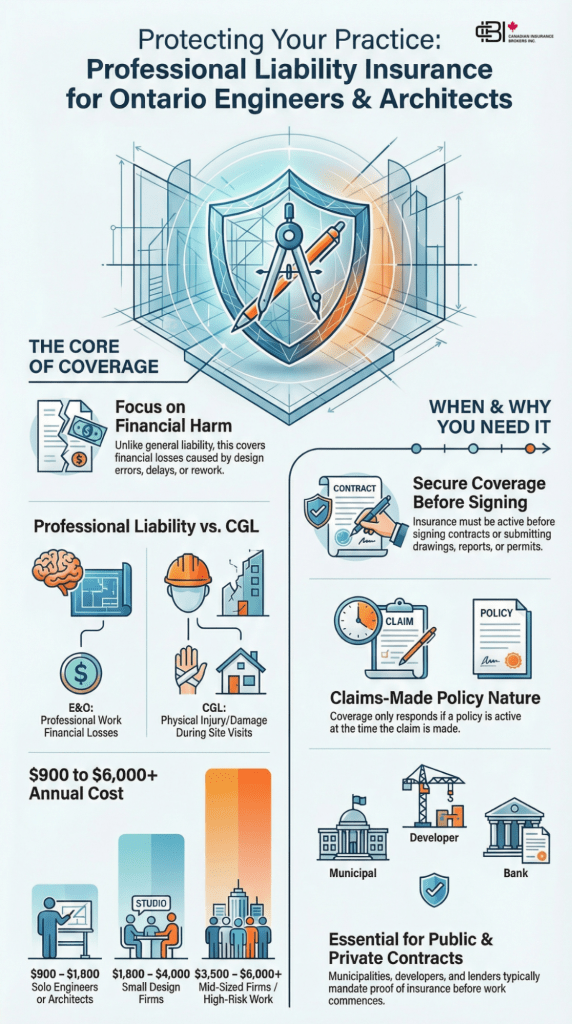
Unlike general liability insurance, which covers bodily injury or property damage, professional liability insurance focuses on financial harm. In many claims, no physical damage occurs at all. A client may simply believe that a design decision, assumption, or omission contributed to delays, rework, or added costs.
Engineering and architectural work is contract-based and relied on by multiple parties, which increases exposure to claims and makes insurance important for protecting income, reputation, and the ability to continue practicing.
Who This Coverage Is For
Coverage can be arranged for professionals providing engineering, architectural, and technical design services, including:
- Mechanical engineers
- Civil and structural engineers
- Electrical engineers
- Chemical engineers
- Geotechnical engineers
- Management and consulting engineers
- Architects and architectural technologists
- Residential and commercial architects
- Architectural designers and interior designers
- Drafters and building permit designers
- Technical designers
- Landscape and restoration architects
- Architectural engineers
Insurance can be structured for self-employed professionals, sole proprietors, incorporated businesses, partnerships, and firms using employees or subconsultants.
How Engineering and Architecture Firms Are Commonly Structured
Many engineers and architects work independently or through small firms, while others operate as incorporated practices working on larger commercial or public-sector projects.
Contracts are often issued in the name of the firm, but claims may still name individual professionals, directors, or partners. Projects frequently involve multiple consultants, which means liability can extend beyond the party that issued the drawings or reports.
Insurance should reflect how work is reviewed, signed off, and delivered across the project team.
When Engineers and Architects Need Coverage
Engineers and architects should have insurance in place before their work is relied on by others. Waiting until a project is underway or after a contract is signed can create gaps that are difficult to fix later.
Insurance is typically arranged or required:
- Before signing a client contract or engagement letter
- Before submitting drawings, reports, or permit packages
- When registering or incorporating a firm
- Before working with developers, municipalities, or public-sector clients
- When providing services to Toronto or the U.S. based clients
- When hiring staff, interns, or subconsultants
- When taking on higher-value or higher-risk projects
Professional liability insurance is usually written on a claims-made basis, which means coverage responds only if a policy is in place when a claim is made. This makes early and continuous coverage especially important for engineers and architects.

Core Insurance Coverages for Engineers and Architects
- Professional Liability (Errors and Omissions): Covers claims related to design work, calculations, drawings, specifications, reports, and professional judgment.
- Commercial General Liability (CGL): Covers bodily injury or property damage arising from site visits, inspections, or meetings, not design or engineering services.
- Cyber Liability Insurance: Covers breaches, ransomware, or unauthorized access to digital drawings, models, and project files.
- Employers & Non-Owned Auto Liability: Applies when firms employ staff, use subconsultants, or rely on personal vehicles for project-related travel.
What Professional Liability Insurance Actually Responds To
| Allegation | What is being claimed |
|---|---|
| Design error or omission | Professional services caused rework, delays, or added cost |
| Incorrect assumptions | Engineering inputs or site data were relied on and later disputed |
| Scope disagreement | Client expected services that were not clearly documented |
| Professional standard dispute | Allegation that work did not meet accepted industry standards |
| Reliance on reports or drawings | Third parties relied on professional documents and suffered loss |
Real Claim Examples Involving Engineers and Architects



Example: The City of Richmond filed a lawsuit against an architectural firm involved in the Minoru Centre for Active Living project, alleging design and drawing deficiencies that contributed to construction issues and added costs.
How insurance helps: Architect professional liability insurance can help cover legal defence costs and respond to claims alleging that design services caused financial loss.
Example: In New Brunswick, a suspended engineer faced several lawsuits tied to alleged structural design flaws that required remediation and delayed project completion.
How insurance helps: Professional liability insurance can help cover defence costs and potential settlements when engineering services are questioned.
Example: The City of Toronto filed a claim against an engineering firm alleging design deficiencies related to major highway rehabilitation work, seeking recovery of significant project costs.
How insurance helps: Engineering professional liability insurance can help respond to claims involving alleged design errors, omissions, or failure to meet professional standards on large public projects.
How Much Does Engineers & Architects Insurance Cost in Ontario?
Costs vary based on services, revenue, and project exposure. Typical ranges include:
- Solo engineers or architects: $900 to $1,800 per year
- Small firms: $1,800 to $4,000 per year
- Mid-sized firms or higher-risk work: $3,500 to $6,000+ per year
- Cyber liability coverage: $150 to $600 per year
Ontario Service Areas We Serve
James Inwood works with engineers and architects in:
- Oakville
- Mississauga
- Burlington
- Milton (including Campbellville)
- Georgetown
- Halton Hills (including Acton)
- Hamilton
- Toronto
- Surrounding Ontario areas
Oakville and the surrounding Halton Region support a large number of consulting and design firms. Many local engineers and architects work with Toronto or U.S.-based clients who require proof of professional liability and cyber coverage before any work begins.
Why Work With James Inwood
James Inwood works with engineers and architects at the point where contracts, projects, and insurance overlap. He regularly reviews service agreements and insurance requirements to help ensure coverage is in place before drawings are issued or work begins.
Clients value the practical approach, clear communication, and confidence that coverage has been reviewed with real project conditions in mind.
How to Get Engineering & Architect Insurance
- Review your services and contracts
- Confirm required limits, wording, and certificates
- Arrange professional liability as the foundation
- Add supporting coverage where required
- Issue certificates that meet client requirements
If you are an engineer or architect, request a quote or send your contract for review to confirm your insurance is structured correctly.
Visual: Professional Liability Insurance for Ontario Engineers & Architects
Frequently Asked Questions
It can. Claims often arise when revised drawings or updated designs are relied on and later linked to delays, rework, or added costs. Coverage depends on how the policy is structured and the nature of the allegation.
Yes. Subconsultants are frequently named directly in claims, even when working under another firm. Many prime consultants also require subconsultants to carry their own professional liability insurance.
Coverage for past projects depends on whether prior acts coverage is included. Gaps in coverage can leave earlier work exposed, which is why policy transitions need to be handled carefully.
It often does when claims relate to professional judgment, observations, or reporting. Site involvement is a common source of claims for engineers and architects.
Yes. Permit-related work and code reviews can lead to claims if approvals are delayed or later questioned. Many clients and municipalities expect insurance for these services.

James Inwood
James Inwood is a Canadian insurance advisor specializing in professional liability insurance for engineers and architects across Oakville, the Halton Region, Burlington, Milton, Hamilton, Toronto & more.