



Product Liability Insurance in Canada
We provide professional insurance guidance for businesses and individuals through a secure and confidential quote process designed to be clear, efficient, and easy to begin.
Locally established in Oakville, Ontario
Coverage designed to match your business needs
Insurance options reviewed across markets and emailed to you
Product Liability Insurance in Canada
We provide professional insurance guidance for businesses and individuals through a secure and confidential quote process designed to be clear, efficient, and easy to begin.
Locally established in Oakville, Ontario
Coverage designed to match your business needs
Insurance options reviewed across markets and emailed to you

Product liability insurance is one of the most important types of coverage for businesses that manufacture, distribute, or sell products. While many companies focus on property or general liability insurance, product-related risks are often underestimated until something goes wrong.
A defective or unsafe product can lead to injury, property damage, or financial loss for a customer. When that happens, the business involved may be held legally responsible, even if the issue originated elsewhere in the supply chain.
In Canada, product liability claims can escalate quickly. Legal costs, settlements, and reputational damage can all become significant. Understanding how this type of insurance works is what helps businesses protect themselves before those risks turn into real losses.
At a Glance: Product Liability Insurance
- Covers injury or damage caused by defective products
- Applies across the supply chain, including manufacturers and retailers
- Includes legal defence costs and settlements
- Often built into general liability insurance
- Critical for both small businesses and large-scale manufacturers
Understanding Product Liability From a Business Perspective
Product liability insurance is a form of liability coverage that protects a business when a product it is connected to causes harm. This includes products that are manufactured, assembled, imported, distributed, or sold.
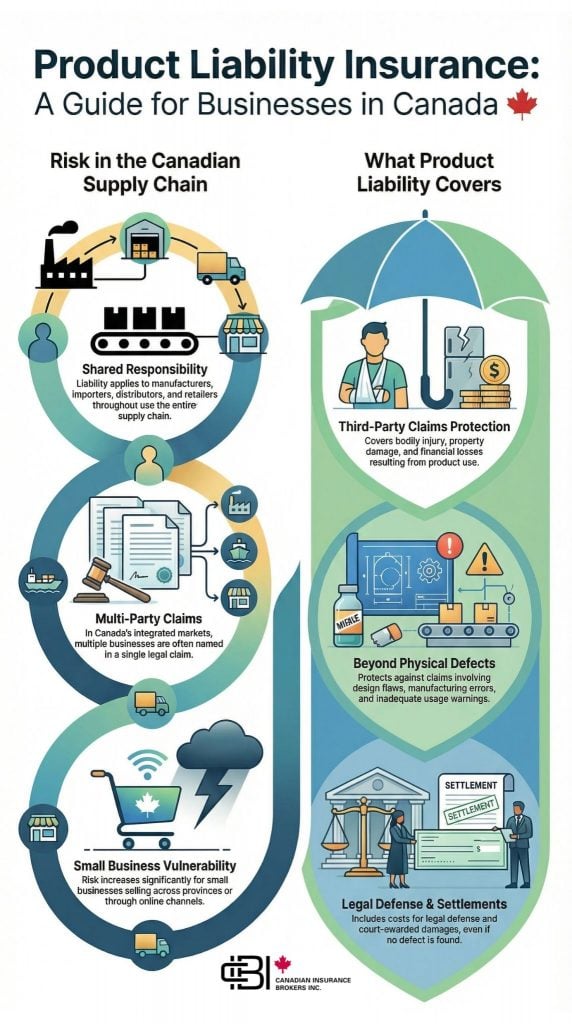
From an insurance standpoint, responsibility does not stop at manufacturing. A distributor, retailer, or contractor can all be named in a claim, even if they did not create the defect.
This is particularly relevant in Canadian manufacturing and supply chains, where products often move through multiple stages before reaching the end user. Each stage introduces potential exposure, and insurance is designed to respond to that shared risk.
How Product Liability Exposure Develops
Product liability risk does not always come from obvious defects. In many cases, it develops through a combination of design, production, and usage factors. A claim may arise from:
- A flaw in product design
- An error during manufacturing
- Inadequate instructions or warnings
- A foreseeable misuse of the product
For Canadian manufacturers and distributors, this layered exposure is important. Even if quality control is strong, the way a product is used in real-world conditions can still lead to liability. Insurance is structured to respond when that liability becomes a legal issue.
Where Product Liability Insurance Fits Within Your Policy
Product liability insurance is typically included as part of a commercial general liability policy, although it can also be structured separately depending on the nature of the business. When a claim occurs, the policy responds by covering:
- Legal defence costs
- Settlements or court-awarded damages
- Associated liability expenses
The key point is that coverage applies after the product has been sold or distributed. Once the product is in the hands of a customer, any resulting injury or damage may trigger a claim.
What This Coverage Is Designed to Protect
Product liability insurance focuses on third-party claims. It is not about protecting the product itself, but about protecting the business from legal responsibility. Coverage generally applies to:
- Bodily injury caused by a product
- Property damage resulting from product use
- Legal costs associated with defending a claim
- Financial damages awarded to affected parties
For example, if a manufactured component fails and causes damage in a commercial setting, multiple businesses in the supply chain may be involved in the claim. Insurance helps manage the financial impact of that situation.
Coverage Gaps Businesses Often Miss
Many businesses assume their general liability policy fully protects them, but that is not always the case. Common gaps include:
- Insufficient liability limits for larger claims
- No coverage for product recalls
- Exclusions related to specific product types
- Policies that do not reflect current operations
These gaps often become visible only after a claim is made, which is why regular review is important.
Who Should Be Thinking About Product Liability
Product liability insurance is not limited to large manufacturers. It applies to a wide range of businesses involved in bringing products to market. This includes:
- Canadian manufacturers and fabricators
- Importers sourcing products internationally
- Distributors moving goods across regions
- Retailers, including e-commerce businesses
- Contractors supplying products as part of their work
For small businesses, especially those selling online or across provinces, exposure can grow quickly without being immediately obvious.
Product Liability in Canadian Manufacturing and Supply Chains
Canada’s manufacturing sector relies heavily on integrated supply chains. Products often move through multiple businesses before reaching the final customer.
This creates shared responsibility. If a product fails, multiple parties may be named in a claim. A manufacturer, distributor, and retailer can all be involved, depending on how the issue occurred and how the product was used.
In Canada, where manufacturing and distribution remain key industries, product liability insurance is often considered a core coverage rather than an optional one. Businesses that operate at scale or supply larger contracts are particularly exposed.
Strengthening Your Coverage Before a Claim Happens
Product liability insurance is most effective when it is aligned with how your business actually operates.
That includes understanding where your exposure exists within the supply chain and ensuring your policy reflects that risk. Reviewing limits, exclusions, and how products are distributed can make a significant difference in how coverage responds.
Get a quote to see how product liability insurance fits into your current business coverage.
What Influences Product Liability Insurance Cost
The cost of product liability insurance depends on how the insurer evaluates risk. Key factors include:
- The type of product being manufactured or sold
- The potential severity of injury or damage
- Annual revenue and distribution scale
- Claims history
- Coverage limits selected
Higher-risk products typically carry higher premiums, but even lower-risk businesses need coverage because liability exposure can still arise unexpectedly.
Common Product Liability Risks and Their Financial Impact
| Risk Type | Typical Scenario | Estimated Cost Range | Coverage Type |
|---|---|---|---|
| Manufacturing Defect | Faulty product causing injury or damage | $25,000 to $500,000+ | Product Liability Insurance |
| Design Defect | Unsafe product design affecting multiple users | $50,000 to $1,000,000+ | Product Liability Insurance |
| Failure to Warn | Missing instructions or safety warnings | $10,000 to $250,000+ | Product Liability Insurance |
| Product Recall | Removing defective products from market | $20,000 to $500,000+ | Recall / Endorsement Coverage |
| Legal Defense Costs | Lawyers, court fees, settlements | $15,000 to $300,000+ | Included in Liability Policies |
Why Product Liability Risk Is Increasing
Product liability exposure has grown in recent years due to several factors.
Products are more widely distributed, often through online channels. Customer expectations are higher, and legal environments have become more complex. At the same time, manufacturing processes and supply chains are more interconnected than ever.
For Canadian businesses, this means that a single issue can affect a larger number of customers and lead to more complex claims.
Why Strong Liability Coverage Is Critical for Your Business
The financial impact of product liability claims continues to increase. Legal costs, settlements, and reputational damage can all affect a business long after the initial issue.
For businesses in Canada, particularly those involved in manufacturing or distribution, having the right coverage in place is a key part of long-term stability.
Get a quote before a claim happens to ensure your business is properly protected.
Visual: Product Liability Insurance (A Guide for Businesses in Canada)
Why Work With James Inwood
James Inwood works with business owners across Ontario to help them understand how liability risks affect their operations.
Product liability is often one of the most overlooked exposures, especially for small and mid-sized businesses. His approach focuses on identifying where risk exists within the supply chain and ensuring coverage is structured to respond effectively.
By working with multiple insurers, he helps clients compare options and find coverage that reflects how their business actually operates.
Get a quote or book a quick call with James Inwood to assess your product liability exposure.
Frequently Asked Questions
Yes. Legal defence costs are typically included and can be a significant part of a claim, even when no damages are awarded.
Yes. Claims often involve multiple parties across the supply chain, including manufacturers, distributors, and retailers.
In many cases it is included, but coverage limits and exclusions vary. It is important to review how it applies to your specific business.
Yes. Even small businesses can face significant claims if a product causes injury or damage, especially when products are sold online or distributed widely.

James Inwood is an Oakville-based insurance advisor who works with businesses across Ontario. He focuses on helping companies understand how insurance performs in real-world situations, including liability risks, coverage gaps, and claims.
His approach is grounded in practical experience, with a focus on aligning policies with how businesses actually operate.
James Inwood, Insurance Broker
RIBO licensed | LinkedIn

