







Insurance brokerage team reviewing insurance exclusions and policy details together at a laptop.

What Are Insurance Exclusions? A Practical Guide for Ontario Policyholders

What Are Insurance Exclusions? A Practical Guide for Ontario Policyholders

We provide professional insurance guidance for businesses and individuals through a secure and confidential quote process designed to be clear, efficient, and easy to begin.

Locally established in Oakville, Ontario

Coverage designed to match your business needs

Insurance options reviewed across markets and emailed to you

What Are Insurance Exclusions? A Practical Guide for Ontario Policyholders

We provide professional insurance guidance for businesses and individuals through a secure and confidential quote process designed to be clear, efficient, and easy to begin.

localise

Locally established in Oakville, Ontario

coverage

Coverage designed to match your business needs

localise

Insurance options reviewed across markets and emailed to you

Insurance policies are designed to protect against risk, but they do not cover everything. The details that define what is not covered are known as exclusions, and they play a critical role in how a policy responds when a claim is made.

For homeowners, drivers, and business owners across Ontario, including Oakville, Burlington, Milton, Mississauga, and surrounding Halton Region communities, exclusions often become most important at the worst possible moment. Many claims are not denied because a policy is missing, but because the situation falls outside what the policy was designed to cover.

Understanding how exclusions work before a claim happens helps avoid misunderstandings, unexpected costs, and gaps in protection.

At a Glance: Insurance Exclusions in Ontario

Insurance exclusions define the limits of coverage. These are the key points most policyholders should understand:

  • Exclusions are specific situations or risks that a policy does not cover
  • They appear in all types of insurance including home, auto, life, and business
  • Some exclusions can be added back through endorsements or optional coverage
  • Exclusions are one of the main reasons claims are denied
  • Reviewing exclusions is just as important as reviewing coverage limits

Many homeowners and business owners only realize what their policy excludes after a loss. Reviewing exclusions ahead of time helps ensure coverage reflects real-world risks.

Flooded home showing a water damage risk that may be affected by insurance exclusions in Ontario property policies.
Water damage is one of the most important insurance exclusions to review, especially for flooding and sewer backup coverage.

Common Home Insurance Exclusions in Ontario

Home insurance policies in Ontario include several exclusions that homeowners should understand before a claim occurs. Typical exclusions include:

  • overland flooding without additional coverage
  • sewer backup without endorsement
  • damage from pests such as rodents or insects
  • mould caused by long-term moisture issues
  • wear and tear or aging systems

Get a quote to compare home insurance options that address common exclusions like water damage, flooding, and property-specific risks.

Business Insurance Exclusions

Business policies often contain more complex exclusions due to the variety of risks involved.

Common commercial general liability insurance exclusions include:

Business interruption insurance exclusions may include:

  • interruptions not caused by insured physical damage
  • utility failures outside insured premises
  • pandemics or government shutdowns (depending on wording)

Cyber insurance exclusions may include:

  • outdated security systems
  • failure to maintain software updates
  • insider threats in certain circumstances

For business owners in Ontario, these exclusions can significantly affect how a policy responds during operational disruptions.

Life Insurance Policy Exclusions

Life insurance policies also contain exclusions, particularly in the early years of coverage. Common exclusions in life insurance policies include:

  • suicide within the first two years of the policy
  • misrepresentation on the application
  • high-risk activities not disclosed
  • certain pre-existing medical conditions

These exclusions are often time-limited or tied to disclosure requirements, which makes accuracy during the application process critical.

Real Scenario: When an Insurance Exclusion Matters

A homeowner in Oakville experienced basement flooding after heavy rainfall. They assumed their home insurance would cover the damage, as the policy included water damage protection.

However, the claim was partially denied because the damage was caused by overland flooding, which was excluded under their standard policy. Sewer backup coverage was in place, but flood coverage had not been added.

The result was that part of the damage was covered, while the portion related to external flooding was not. Situations like this are not uncommon. They highlight the importance of understanding how exclusions apply to different types of risk.

Key Factors That Influence Insurance Exclusions

Insurance exclusions are not random. They are often shaped by how a property is used, where it is located, and the type of policy in place. The factors below commonly influence whether coverage gaps appear in home, business, or property insurance.

Property Location

High Impact

Homes and businesses in areas with higher flood, theft, or weather-related exposure often face more policy restrictions or optional coverage requirements.

Property Usage

High Impact

How a property is used matters. Home-based businesses, rental use, vacancy, or seasonal occupancy can all create exclusions under a standard policy.

Policy Type

Moderate Impact

Exclusions vary by policy. What is excluded under a standard home or business policy may be available through endorsements or separate coverage.

Maintenance History

Moderate Impact

Damage tied to neglect, wear and tear, or poor upkeep is frequently excluded. Insurers generally expect policyholders to maintain the property properly.

Environmental Risk

High Impact

Risks such as overland flooding, wildfire exposure, and sewer backup can influence whether coverage is excluded by default or offered only as an add-on.

Practical takeaway: The more a property falls outside standard residential or commercial risk patterns, the more important it becomes to review exclusions carefully and ask whether optional coverage is available.

Why Many Ontario Policyholders Overlook Exclusions

A common pattern when reviewing policies is that most attention goes to price and coverage limits, while exclusions receive less attention.

This happens because:

  • policy wording is complex
  • exclusions are often grouped in dense sections
  • assumptions are made based on past claims or experiences
  • coverage is not reviewed after major life changes

In practice, exclusions tend to matter most after:

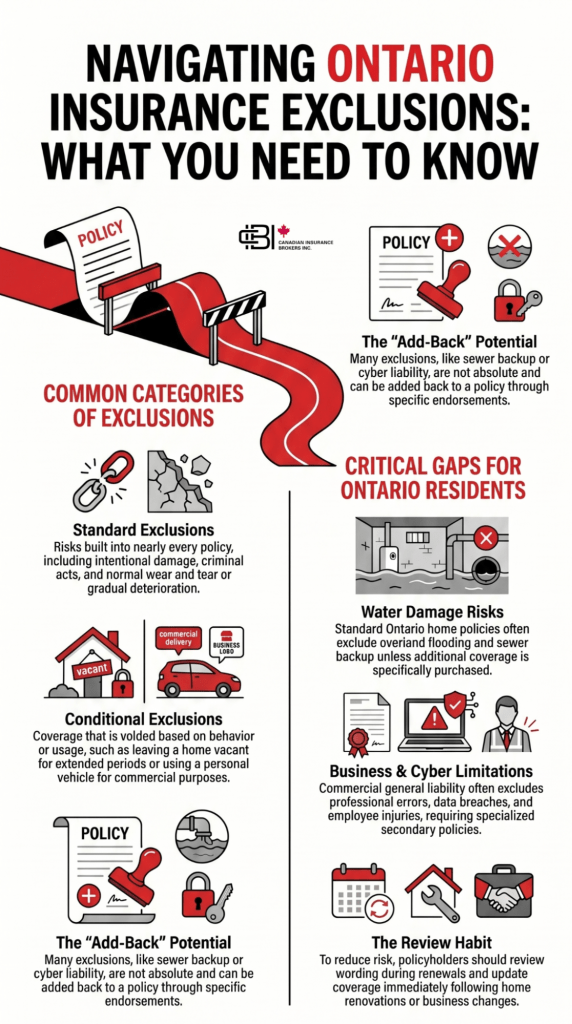
Navigating Ontario insurance exclusions
An overview how Ontario insurance exclusions can help homeowners and business owners spot coverage gaps before a claim happens.

Why Work With James Inwood

James Inwood is an insurance broker based in Oakville who works directly with homeowners and business owners across Halton Region. His office is close to Kerr Village, and he regularly supports clients in areas such as Glen Abbey, Bronte, and along the waterfront.

Because exclusions are often where coverage issues arise, having someone walk through those details can make a significant difference. Clients often discover that small adjustments to their policy can prevent larger problems later.

If you want to review your current policy or compare options, you can get a quote or book a call to go through your coverage in more detail.

Frequently Asked Questions

Most policies exclude intentional damage, wear and tear, and high-risk events such as flooding or cyber incidents unless additional coverage is added.

Not necessarily. Some exclusions can be covered through endorsements or additional policies depending on the risk.

No. While many exclusions are similar, wording and coverage options can vary between insurers.

Your policy document includes a section outlining exclusions. Reviewing this section with a broker can help clarify how it applies to your situation.

Some exclusions cannot be removed, but many can be addressed through optional coverage or endorsements.

James Inwood, insurance broker, presenting common insurance exclusions including intentional loss, flooding, and wear and tear.
James Inwood explains key insurance exclusions that can affect what is and is not covered under a policy.

James Inwood is a Canadian insurance advisor specializing in personal and commercial insurance across Ontario. Based in Oakville, he helps homeowners and businesses understand how insurance policies work in real-world situations. His work focuses on helping clients identify risks, understand exclusions, and make informed decisions about coverage. He supports clients across Oakville and Halton Region with guidance on renewals, claims, and policy reviews.

James Inwood, Insurance Broker
RIBO licensed | LinkedIn

Leave a Comment

Your email address will not be published. Required fields are marked *