








Insurance Premium Meaning (Car, Home, Life)
We provide professional insurance guidance for businesses and individuals through a secure and confidential quote process designed to be clear, efficient, and easy to begin.
Locally established in Oakville, Ontario
Coverage designed to match your business needs
Insurance options reviewed across markets and emailed to you
Insurance Premium Meaning (Car, Home, Life)
We provide professional insurance guidance for businesses and individuals through a secure and confidential quote process designed to be clear, efficient, and easy to begin.
Locally established in Oakville, Ontario
Coverage designed to match your business needs
Insurance options reviewed across markets and emailed to you

The term “insurance premium” appears in every type of policy, whether it is car insurance, home insurance, or life insurance. It is often described simply as the cost of insurance, but that explanation only covers the surface.
In practice, a premium reflects how an insurer evaluates risk. It considers the likelihood of a claim, the level of coverage selected, and how that risk is priced over time. The same concept applies across policies, but the way premiums are calculated can vary depending on what is being insured.
Across Ontario, most confusion does not come from the definition itself. It comes from how premiums behave differently depending on the type of insurance. Understanding that difference makes premiums easier to compare and evaluate properly.
At a Glance: Premium Meaning in Insurance
- A premium is the cost of keeping an insurance policy active
- It can be paid monthly, annually, or on another schedule
- It reflects risk, coverage level, and insurer pricing models
- Different policies calculate premiums differently
- Premiums include a base cost plus adjustments
- Specialized terms affect how premiums behave
- Price alone does not determine value
What Is a Premium in Insurance?
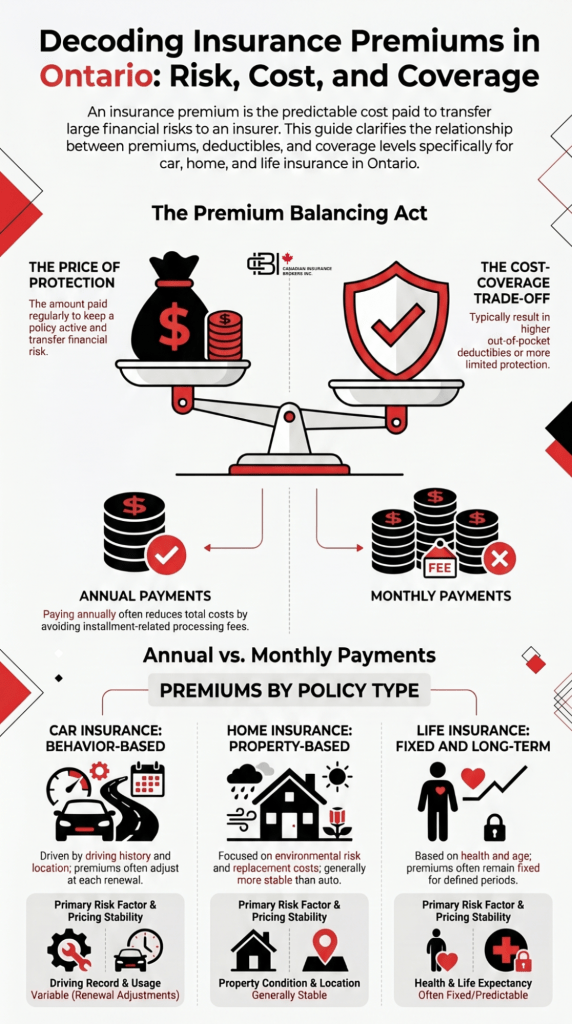
A premium in insurance is the amount paid to an insurer in exchange for financial protection against specific risks.
At a practical level, it represents a trade-off. Instead of facing a potentially large and unpredictable expense, the policyholder pays a smaller, predictable amount so the insurer assumes that risk.
This applies across all major insurance types:
- Car insurance premiums relate to accident risk
- Home insurance premiums relate to property damage and liability
- Life insurance premiums relate to long-term financial risk
While the definition stays consistent, the structure behind each premium is different.
Insurance Premium vs Deductible vs Coverage
Insurance premiums are often confused with other key parts of a policy. Each one serves a different role.
- Premium: the amount paid regularly to maintain the policy
- Deductible: the portion paid out of pocket before coverage applies
- Coverage: the protection provided by the policy
These three elements are connected. A lower premium often comes with a higher deductible or more limited coverage, while a higher premium may provide broader protection or lower out-of-pocket costs.
Understanding this relationship is what allows for meaningful comparison between policies.
Insurance Premium Meaning by Type
Car Insurance
Car insurance premiums are largely driven by driving-related risk. Insurers evaluate how likely a driver is to be involved in an accident and how expensive that accident could be.
Key factors include:
- Driving history and claims record
- Age and experience
- Vehicle type
- Location and usage
- Coverage selections
Because these factors can change, car insurance premiums are often adjusted at renewal.
Home Insurance
Home insurance premiums are based on property risk rather than behaviour. The focus is on the likelihood of damage to the home and the cost to repair or rebuild it.
This typically includes:
- Property location and environmental risk
- Age and condition of the home
- Replacement cost
- Claims history
- Security features
Home insurance premiums tend to be more stable, but they can still change over time.
Life Insurance
Life insurance premiums are structured around long-term risk. Instead of short-term events, insurers evaluate factors that affect life expectancy and financial exposure.
These include:
- Age at application
- Health and medical history
- Lifestyle factors
- Policy type (term or permanent)
- Coverage amount
In many cases, life insurance premiums remain fixed for a defined period, making them more predictable than other types of insurance.
What Affects Your Insurance Premium
Insurance premiums are influenced by risk, coverage choices, and policy type. The chart below shows how common premium factors may carry different weight across car, home, and life insurance.
Illustrative comparison only. Actual premium calculations vary by insurer, underwriting model, policy type, and individual circumstances.
Types of Insurance Premium
Annual Premium
An annual premium is the total cost of a policy paid once per year. Paying annually can sometimes reduce the overall cost by avoiding installment-related fees.
Monthly Premium
A monthly premium spreads the cost of coverage into smaller payments throughout the year. This can make insurance easier to manage financially, though the total annual cost may be slightly higher.
Base Premium
The base premium is the starting cost of an insurance policy before adjustments are applied. It represents the insurer’s standard pricing for a given level of risk.
From there, the final premium is adjusted based on:
- Discounts
- Surcharges
- Coverage add-ons
Waiver of Premium
A waiver of premium is a life insurance feature that allows the policyholder to stop making payments if certain conditions are met, typically disability.
The policy remains active even though premiums are no longer required under those conditions.
Premium Rebating
Premium rebating refers to returning part of the premium as an incentive. In many regulated markets, this practice is restricted to ensure fair pricing standards.
Instead of direct rebates, insurers typically offer structured discounts within the policy.
Get a quote to compare insurance premiums across car, home, and life policies based on your risk profile, coverage needs, and pricing structure.
What Your Insurance Premium Actually Tells You
A premium is not just a price. It reflects how the policy is structured and what level of protection is being provided.
A lower premium may indicate:
- Higher deductible
- More limited coverage
- Greater restrictions
A higher premium may reflect:
- Broader coverage
- Higher limits
- Lower out-of-pocket costs
The key is understanding what the premium includes rather than focusing on the number alone.
Why Work With James Inwood
Insurance premiums are often compared at face value, but the structure behind them determines how a policy performs when it matters. Two policies can look similar in price but behave very differently in a claim situation.
James Inwood works with clients across Ontario to break down how premiums are built and how different insurance products compare beyond just cost. This includes reviewing car, home, and life insurance policies to ensure coverage aligns with real risk.
Get a quote or book a call with James Inwood to review your insurance options.
Frequently Asked Questions
Different insurers use their own models to assess risk, which can lead to different pricing for similar coverage. Even small differences in how risk is evaluated can affect the final premium. This is why comparing quotes from multiple providers can produce different results. The variation is usually tied to underwriting approach rather than random pricing.
Many policies allow flexibility in payment frequency, such as switching between monthly and annual payments. This does not change the coverage itself, but it can affect how the cost is distributed over time. Some insurers may charge small fees for monthly payments. Choosing the right option depends on cash flow preferences.
Not always. Some policies, such as term life insurance, can have fixed premiums for a set period. Others, like car insurance, may change more frequently based on claims, risk, or market conditions. The direction of change depends on the type of insurance and individual circumstances. Premiums can increase, decrease, or stay the same.
In some cases, yes. Adjustments such as qualifying for discounts, improving risk factors, or reviewing policy structure can reduce premiums. However, removing coverage is not the only way to lower cost. The key is making changes that improve how the insurer evaluates risk rather than simply reducing protection.

James Inwood is an Ontario-based insurance broker who works with individuals and businesses across car, home, and life insurance. He focuses on helping clients understand how insurance works in real situations, including pricing structure, coverage decisions, and long-term planning. His approach is practical and focused on aligning insurance policies with how risk actually exists.
James Inwood, Insurance Broker
RIBO licensed | LinkedIn

