








Two students standing in a shared apartment with backpacks, representing student housing insurance for renters and shared living spaces.

Student Rental House Insurance in Ontario

Student Rental House Insurance in Ontario

We provide professional insurance guidance for businesses and individuals through a secure and confidential quote process designed to be clear, efficient, and easy to begin.

Locally established in Oakville, Ontario

Coverage designed to match your business needs

Insurance options reviewed across markets and emailed to you

Student Rental House Insurance in Ontario

We provide professional insurance guidance for businesses and individuals through a secure and confidential quote process designed to be clear, efficient, and easy to begin.

localise

Locally established in Oakville, Ontario

coverage

Coverage designed to match your business needs

localise

Insurance options reviewed across markets and emailed to you

Student rental house insurance usually looks simple from the outside. A landlord rents a property to students. A student moves into a shared house, condo, or off-campus apartment. Insurance is assumed to be handled somewhere along the way. That assumption is where most of the issues begin.

Across Ontario, student rental insurance follows similar patterns, but the risk is not always the same. In cities with large student populations like Toronto, Waterloo, London, and Kingston, shared housing, turnover, and density all change how insurance behaves in practice.

What people call “student rental insurance” is not one policy. It is a mix of landlord coverage, tenant coverage, contents protection, and liability.

The problem is not that insurance is missing. It is that people misunderstand how it actually works.

At a Glance: Student Rental Insurance

  • Student rental insurance is usually split between landlord and tenant responsibilities
  • Property insurance typically protects the building, not the student’s belongings
  • Renters insurance covers contents, liability, and temporary living costs
  • Liability is often the largest financial risk in shared housing
  • Many issues come from assumptions, not lack of coverage
  • In Ontario, higher costs make even small losses more significant
Minimal student bedroom with single bed, desk, and wardrobe, illustrating student housing insurance coverage for basic living spaces.
A simple student rental bedroom setup, highlighting the importance of student housing insurance for protecting personal belongings.

What Student Rental Insurance Actually Means

Student rental insurance is not a single policy. It is a combination of different types of coverage that apply to different people within the same property.

In most situations:

  • Landlords carry insurance for the building and their liability
  • Students carry renters insurance for their belongings and personal liability

These policies operate separately, even though they apply to the same space. That is where confusion often happens. One side assumes coverage extends further than it actually does.

Understanding this split is the starting point. Without it, most insurance decisions in student housing are based on assumptions rather than how policies actually work.

It Is Not One Policy, It Is Two Separate Systems

One of the most common misunderstandings is thinking that student housing is covered under a single policy.

In reality, there are two separate systems operating at the same time.

  • The landlord’s insurance protects the property and their liability
  • The student’s insurance protects their belongings and their personal liability

They apply to the same space, but they do not overlap the way people expect. This is where gaps form. A student assumes the landlord’s policy covers their belongings. A landlord assumes the tenant has coverage in place.

Neither assumption is guaranteed to be correct.

Why University Cities Change the Risk Profile

Student housing behaves differently depending on where it is located.

In Ontario university cities:

  • Toronto brings higher replacement costs and tighter housing conditions
  • Waterloo and Guelph have dense student neighborhoods with frequent turnover
  • London and Hamilton often involve older housing and shared living setups
  • Ottawa and Kingston combine student rentals with long-term residential use
  • Sudbury and St. Catharines may have fewer units but less standardized setups

These differences matter because they influence how often claims happen and how severe they can be.

Higher density increases frequency. Older housing increases vulnerability. Higher costs increase the financial impact.

Where Risk Quietly Builds Up

Student housing does not usually fail because of one major event. It is usually a series of small assumptions that build up over time.

Shared kitchens, furnished spaces, multiple tenants, and frequent turnover all create situations where responsibility is not always obvious.

That does not automatically create risk. What creates risk is when:

  • Roles are unclear
  • Expectations are not defined
  • Coverage is assumed instead of confirmed

This is why student housing insurance feels simple at the beginning and complicated later.

The Risk That Actually Hurts: Liability

Most people focus on damage. Insurance tends to focus on liability.

In student housing, liability can come from:

  • A fire linked to tenant activity
  • Water damage affecting other units
  • Injury within the property
  • Disputes over negligence in shared areas

These are not edge cases. They are normal situations in shared housing.

What matters is not just what happened, but who is considered responsible.

What Students Are Actually Responsible For

Students often assume that insurance is already handled through the landlord or building.

In most cases, their responsibility includes:

  • Personal belongings
  • Personal liability
  • Temporary living costs after a loss

That is where renters insurance becomes relevant.

A typical student setup may include:

  • Laptop, phone, and electronics
  • Clothing and personal items
  • Furniture or small appliances
  • School materials

Individually, these may seem manageable. Together, they represent a real financial exposure.

What Landlords Often Overlook

Landlords tend to focus on the building, which makes sense. But student housing introduces additional considerations.

These include:

  • Multiple tenants in one property
  • Higher turnover
  • Shared use of common areas
  • Furnished units

A standard home policy may not always reflect this type of use. The issue is not just having insurance. It is whether the policy matches how the property is actually being used.

The Misleading Idea of a “Fire Insurance Fee”

Questions around fire-related fees in student housing usually point to confusion rather than a defined insurance structure.

Sometimes this comes from lease language. Other times, it comes from trying to understand who pays after a fire-related loss.

There is no universal “fire insurance fee” built into student housing.

What actually matters is:

  • Cause of the loss
  • Whether negligence is involved
  • Lease terms
  • Existing insurance coverage

The cost comes from responsibility, not a standard fee.

Where International Students Run Into Trouble

International students often face a different kind of risk. Not higher risk, but less clarity.

Some assume coverage exists through family insurance. Others assume the landlord or school has everything covered.

In most cases, they still need their own protection.

In Ontario, where replacing even basic belongings can be expensive, this gap becomes noticeable quickly.

What These Situations Look Like in Practice

Most student housing issues follow the same pattern.

A landlord assumes everything in the unit is covered. A student assumes the same thing. A loss happens, and both realize the coverage does not extend as far as they thought.

In shared housing, one event can affect multiple people at once. A fire, for example, may involve building damage, personal belongings, and liability questions all at once.

These situations are not unusual. They are the result of unclear expectations before anything happens.

What Student Rental Home Insurance Actually Costs in Ontario

The cost of student rental insurance is usually lower than people expect.

For students, renters insurance in Ontario typically ranges:

  • Basic: $15 to $30 per month
  • Average: Around $25 to $30 per month

That works out to roughly $300 to $400 per year, which is relatively small compared to replacing belongings or covering liability after a loss.

For landlords, pricing varies more depending on the property. Student rental properties are often:

  • More expensive to insure than standard homes
  • Influenced by occupancy type and usage

The important comparison is not just price. It is the difference between a predictable cost and an unpredictable financial exposure.

How Student Rental Insurance Risk Builds in Ontario

Tenant Turnover

Frequent move-ins and move-outs increase uncertainty and oversight gaps

Very High Impact

Shared Living Spaces

Kitchens, bathrooms, and common areas create unclear responsibility

High Impact

Property Age

Older homes increase the likelihood of plumbing and structural issues

Moderate to High

City Density

Urban environments increase claim frequency and cost severity

High Impact

Furnished Units

More contents increase potential loss and dispute scenarios

Moderate Impact

Where This Is All Heading

Student rental insurance is becoming more specific as housing itself becomes more varied.

Different setups create different needs:

  • Shared houses
  • Condo rentals
  • Off-campus apartments
  • Purpose-built student housing

There is less room for generic coverage. The closer the policy matches the actual setup, the more useful it becomes.

Get a quote to review student rental insurance options based on your specific setup in Ontario.

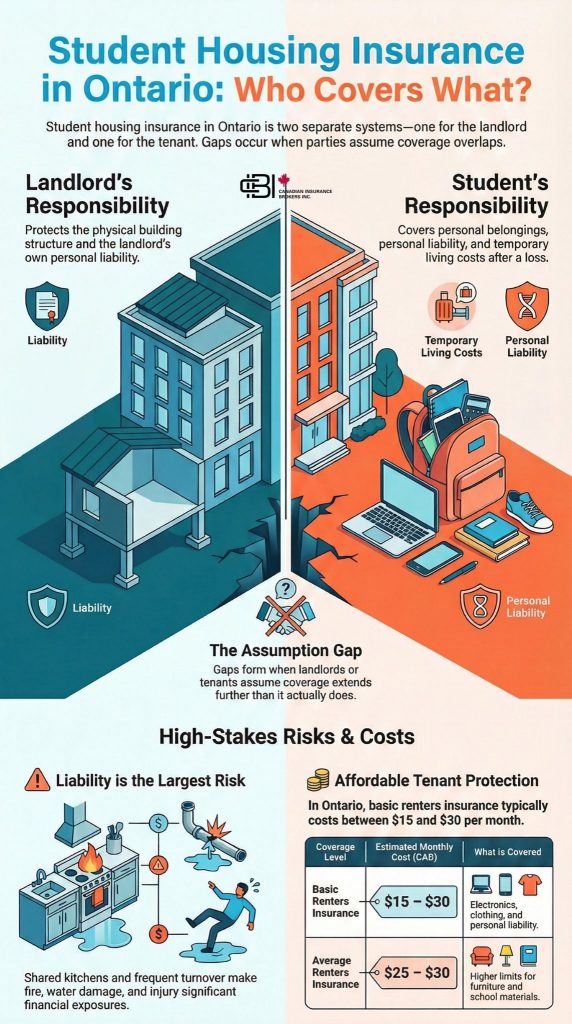
Visual: Student Housing Insurance in Ontario

Student Housing Insurance in Ontario
A breakdown of student housing insurance in Ontario, outlining who covers what and typical costs for tenants.

Why Work With James Inwood

Student rental home insurance is often misunderstood because responsibilities are split between people who assume the other side has it handled.

James Inwood works with Ontario clients to clarify how property insurance, renters insurance, contents coverage, and liability fit together in real situations. The goal is not just to provide a quote, but to make sure coverage reflects how the property is actually used.

Get a quote or book a call with James Inwood to review your student housing insurance.

Frequently Asked Questions

No, coverage is usually separate and applies to different types of risk.

In most cases, yes, especially in higher-cost cities like Toronto.

Liability, particularly in shared living environments.

Because coverage is often misunderstood or assumed rather than confirmed.

James Inwood the insurer standing in front of a student rental house holding a clipboard beside a sign about student housing insurance coverage including liability and personal property.
James Inwood, presenting student housing insurance options for rental properties.

James Inwood is an Ontario-based insurance broker who works closely with landlords, tenants, and families navigating rental and student housing insurance across Toronto.

He regularly helps clients understand how coverage actually works in shared living environments, including where landlord policies stop, where renters insurance begins, and how liability can impact both sides after a loss. 

His approach is practical and advisory, focused on helping clients avoid common gaps in student housing insurance before they become costly problems.

James Inwood, Insurance Broker
RIBO licensed | LinkedIn

Leave a Comment

Your email address will not be published. Required fields are marked *