






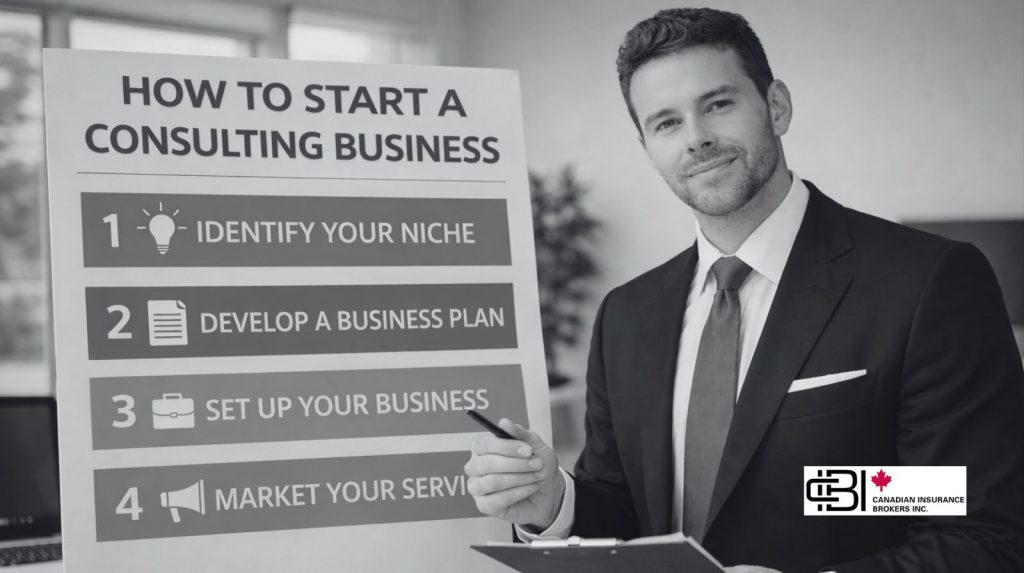
How To Start a Consulting Business in Ontario
We provide professional insurance guidance for businesses and individuals through a secure and confidential quote process designed to be clear, efficient, and easy to begin.
Locally established in Oakville, Ontario
Coverage designed to match your business needs
Insurance options reviewed across markets and emailed to you
How To Start a Consulting Business in Ontario
We provide professional insurance guidance for businesses and individuals through a secure and confidential quote process designed to be clear, efficient, and easy to begin.
Locally established in Oakville, Ontario
Coverage designed to match your business needs
Insurance options reviewed across markets and emailed to you

Starting a consulting business is often described as simple. In many ways, it is. You already have the experience, the knowledge, and the ability to help others solve problems.
What is less simple is turning that into something consistent. In Ontario, consulting continues to grow across industries, especially among professionals moving into independent work. The opportunity is there, but the difference between occasional projects and a stable business usually comes down to structure.
At a Glance: Starting a Consulting Business
- Consulting businesses are relatively low-cost to start
- Most consultants begin with existing experience
- Specialization tends to outperform broad services
- Professional liability is one of the main risks
- Structure and contracts matter early
- Long-term success depends on consistency, not just setup
What Business Consulting Actually Means
Business consulting is the practice of helping organizations make better decisions, improve performance, or solve specific problems using your expertise.
This can apply to areas like:
- Operations
- Safety
- HR and compliance
- Strategy or process improvement
The value is not in delivering a product. It is in influencing decisions and outcomes. That is also what creates exposure if results do not align with expectations.
Where Consulting Risk Actually Begins
Consulting businesses are often seen as low-risk because there is no physical work involved. In reality, exposure begins as soon as your advice influences a decision.
If a client relies on your recommendation and the outcome does not go as expected, the consultant can become part of the responsibility. This may involve financial loss, delays, or operational issues tied to that decision.
What makes this more complex is that liability is not always tied to obvious mistakes. It often comes from how your work is interpreted and applied.
Why Professional Liability Insurance Comes Up So Often
For most consultants, professional liability insurance is the first type of coverage that becomes relevant.
It helps protect against situations where:
- A client claims your advice caused financial loss
- A project outcome does not meet expectations
- There is a dispute over your role or recommendations
Even if a claim does not result in a payout, the cost of responding can still be significant. Legal fees, documentation, and time all add up.
Having broader business insurance also supports how your consulting business is viewed. It signals that you are operating in a structured and professional way.
When Consulting Becomes a Real Business
Most consulting businesses do not begin with a formal launch. They usually start with a situation, such as a project or a request for help, and then repeat.
As this happens, the shift becomes clear. Instead of reacting to opportunities, you begin defining what you offer and how you deliver it.
This is where structure starts to matter. Expectations become clearer, and the business moves beyond one-off work into something more consistent.
Building the Foundation Without Overcomplicating It
The early stage of a consulting business does not require complexity, but it does require clarity. At a minimum, you need:
- A clearly defined service
- A consistent way of working with clients
- Basic agreements that outline expectations
These are simple elements, but they prevent many of the issues that tend to appear later.
From an insurance standpoint, this is also where awareness begins. You do not need everything in place immediately, but you do need to recognize when risk starts to exist.
How Consultants Actually Find Work Early On
Consulting rarely begins with structured marketing systems. Most early work comes from people who already know your background and experience.
This often includes former colleagues, past employers, or industry contacts who trust your work. These relationships typically form the foundation of early projects.
As the business develops, this becomes more structured. Over time, work tends to come from:
- Referrals
- Repeat clients
- Professional networks
The shift is gradual, but it moves the business toward more predictable income.
How Pricing Becomes Clearer Over Time
Pricing is one of the least defined parts of consulting early on. Many consultants start with hourly rates because they are simple and familiar.
As experience builds, pricing often shifts toward:
- Project-based work
- Retainer or ongoing agreements
This allows pricing to reflect value rather than time. It also creates more consistency in how work is delivered.
Real Examples of Consulting Risk in Practice
Consulting risk often comes from how your advice is used, not just what you recommend.
For example, an operations consultant may suggest changes that later lead to delays or added costs. Even if the advice was reasonable, the client may still question whether it contributed to the outcome. In another case, a safety or compliance consultant may provide recommendations, but an incident later exposes gaps, bringing their work into question.
There are also situations where expectations are unclear. A consultant may see their role as advisory, while the client assumes responsibility for results. Without defined scope, this can turn into a dispute.
These are the types of situations where professional liability insurance becomes relevant. It is not just about mistakes, but how your work is interpreted and relied upon.
Typical Startup Costs for a Consulting Business in Ontario
Consulting businesses are usually inexpensive to launch compared to trades, retail, or product-based businesses. The main costs are often business setup, branding, software, and insurance rather than equipment or inventory.
| Cost Area | Estimated Range | How Often It Occurs | Why It Matters |
|---|---|---|---|
| Business Setup | $60 – $300 | One-time | Formalizes the business and allows proper registration |
| Website and Branding | $500 – $2,500+ | Mostly upfront | Supports credibility, positioning, and visibility |
| Tools and Software | $20 – $200/month | Recurring | Helps run operations efficiently and professionally |
| Business Insurance | $300 – $1,500/year | Recurring | Helps protect against liability and client-related risk |
These are directional estimates, not fixed prices. Actual startup costs vary based on the type of consulting work, branding choices, software stack, and insurance needs.
Where Consulting Risk Becomes More Visible
In the early stages, risk is easy to overlook. Projects are smaller and expectations are often informal.
As the business grows, this changes. Clients rely more heavily on your work, and the impact of decisions becomes larger.
Common issues that begin to appear include:
- Unclear scope of responsibility
- Disagreements over outcomes
- Financial impact tied to recommendations
This is typically when professional liability insurance becomes less optional and more necessary.
How Consulting Businesses Grow
Growth in consulting is usually about refinement rather than expansion.
Over time, consultants tend to:
- Focus on a more specific type of work
- Build stronger relationships with repeat clients
- Improve pricing based on experience
As this happens, the business becomes more consistent. At the same time, projects often carry more responsibility, which increases both opportunity and risk.
Get a quote to make sure your coverage keeps up as your consulting business grows.
Visual: Starting a Consultant Business in Ontario (A Risk & Insurance Guide)
Why Work With James Inwood
Consulting businesses often appear simple, but the exposure tied to advice can be significant. Understanding that exposure is an important part of building something stable.
James Inwood works with consultants across Ontario to help align insurance with the work being done. This includes identifying liability risks and ensuring coverage evolves as the business grows.
Get a quote or book a call with James Inwood to set up insurance tailored to your consulting business.
Frequently Asked Questions
Yes, especially for professionals with specialized experience. Demand remains strong across many industries.
Most start with flexible services, then refine into more defined offerings as they gain experience.
Often due to unclear positioning, inconsistent work, or lack of structure rather than lack of skill.
It helps protect against claims tied to advice and supports working with more established clients.

James Inwood is an Ontario-based insurance broker who works with consultants and business owners to help them understand risk, structure their coverage, and build protection that supports long-term growth.
His approach focuses on practical advice and real-world exposure.
James Inwood, Insurance Broker
RIBO licensed | LinkedIn

