

Insurance for Freelancers in Ontario (Remote Work & Liability Guide)
We provide professional insurance guidance for businesses and individuals through a secure and confidential quote process designed to be clear, efficient, and easy to begin.

Locally established in Oakville, Ontario

Coverage designed to match your business needs

Insurance options reviewed across markets and emailed to you

Insurance for Freelancers in Ontario (Remote Work & Liability Guide)

We provide professional insurance guidance for businesses and individuals through a secure and confidential quote process designed to be clear, efficient, and easy to begin.

Locally established in Oakville, Ontario

Coverage designed to match your business needs
Insurance options reviewed across markets and emailed to you

Freelance work is often seen as flexible and independent. You choose your clients, set your schedule, and work from wherever makes sense. What is less visible is the responsibility that comes with it, including your work, agreements, and any issues that arise.
Across Ontario, freelancers operate in different ways. Some work remotely from home, others use co-working spaces, and many manage multiple clients at the same time.
Insurance is not always considered early on, but once you are providing a service for a client, liability becomes part of the work.
At a Glance: Insurance For Freelancers in Ontario
- Covers liability tied to freelance services
- Often used by contractors, consultants, and remote workers
- Helps protect against client disputes and claims
- Can include professional liability and general liability
- Costs are usually manageable for small operations
- Applies whether working from home or shared spaces
- Becomes more important with multiple clients or contracts

What Is Freelance Work?
Freelance work refers to providing services independently rather than as an employee of a company.
Instead of earning a salary, freelancers are typically paid per project, contract, or ongoing agreement. This structure gives more flexibility, but it also shifts responsibility from the employer to the individual.
Freelancers in Ontario may work in areas such as:
- Design and marketing
- Consulting and professional services
- IT and tech development
- Writing and content creation
- Contract-based business services
The key difference is that freelancers operate as their own business, even if it is informal.
How to Start a Freelance Career in Ontario
Starting freelance work usually begins with skills and client demand, not structure.
A typical progression looks like:
- Identify a service you can offer
- Start with small contracts or projects
- Build a client base
- Set up contracts and pricing
- Register business income for tax purposes
Many freelancers start part-time and transition into full-time work later. As the work grows, so does exposure. That is usually when insurance becomes relevant.
Where Freelancers Usually Get Insurance Wrong
Most insurance issues do not come from having no coverage at all. They come from small assumptions about how risk works, especially when managing multiple clients, contracts, and remote work setups.
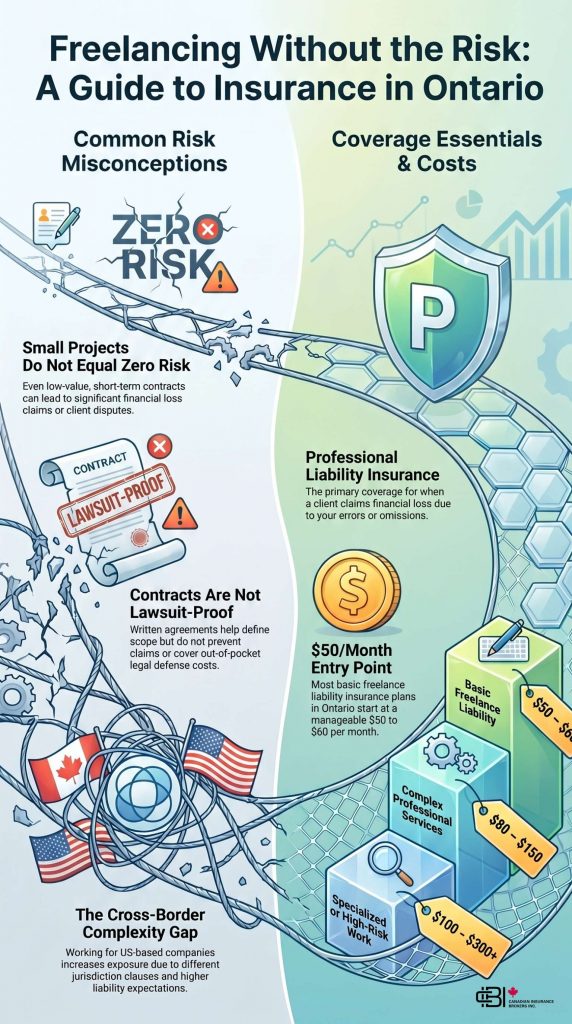
Assuming Small Projects Have No Risk
Even low-value work can lead to disputes
- Short-term contracts still carry responsibility
- Client expectations can change quickly
- Disputes are not tied to project size
Relying Only on Contracts
Contracts help, but do not eliminate liability
- Legal disputes can still arise
- Enforcement may require legal costs
- Contracts do not prevent claims
Working Without Clear Scope
Undefined deliverables increase exposure
- Scope creep issues
- Expectation mismatches
- Payment disputes
Managing Too Many Clients
Increased workload increases error risk
- Overlapping deadlines
- Reduced quality control
- Higher chance of mistakes
| Mistake | Example | Potential Outcome | Why It Matters |
|---|---|---|---|
| No liability coverage | Client claims financial loss from your work | Out-of-pocket legal costs | No protection against claims |
| Relying only on contracts | Dispute escalates despite written agreement | Legal defense required | Contracts do not stop lawsuits |
| Underestimating project risk | Small job leads to unexpected issue | Client dispute or claim | Risk is not tied to project size |
| Multiple clients overlap | Missed deadline affects business outcome | Financial loss claim | Workload increases exposure |
| No clear scope | Client expects additional deliverables | Payment dispute | Undefined expectations create conflict |
These examples reflect common real-world situations freelancers encounter. Actual risk depends on the type of work, number of clients, and contract structure.
What Insurance for Freelancers Includes
Insurance for freelancers is usually a combination of coverages depending on the type of work. This may include:
- Freelance liability insurance (professional liability)
- General liability insurance
- Business equipment coverage
- Cyber or data-related coverage (in some cases)
The structure depends on how you work and what type of services you provide.
Liability Insurance For Freelancers Explained
Freelance liability insurance is often the most important coverage. It typically applies when:
- A client claims financial loss from your work
- An error or omission affects a project
- A dispute leads to legal action
- You are required to defend your work
This type of coverage is especially relevant for consultants, designers, developers, and professionals providing advice or services.
Visual: Freelance Insurance in Ontario
How Much Is Insurance For Freelancers in Ontario?
Insurance for freelancers in Ontario is usually lower than many people expect. Typical ranges:
- Basic freelance liability insurance: $50 to $60 per month
- More complex professional services: $80 to $150 per month
- Higher-risk or specialized work: $100 to $300+ per month
Factors that affect cost:
- Type of freelance work
- Annual income
- Number of clients
- Contract requirements
- Risk exposure
Get a quote to compare insurance options based on your services, number of clients, and contract requirements.
Working From Home vs Co-Working Spaces
- Home office: may require clarification between personal and business coverage
- Co-working space: may involve shared liability or contract requirements
- Client location work: increases exposure to third-party environments
Freelancers often move between these environments, which can create gaps if coverage is not structured properly.
How to Report Freelance Income in Ontario
Freelancers are required to report income as self-employed earnings. This includes:
- Declaring income on tax returns
- Tracking expenses
- Managing HST/GST where applicable
While this is a tax topic, it also connects to insurance. As income increases and work becomes more formal, insurance becomes more relevant, especially when contracts or larger clients are involved.
Working Remotely for a US Company from Canada
Many freelancers in Ontario work remotely for clients based in the United States. While the work may feel the same, cross-border contracts can introduce additional complexity.
This can include:
- Jurisdiction clauses that require disputes to be handled in the US
- Currency and payment structures that affect contract value
- Higher liability expectations from US-based companies
- Insurance requirements with specific coverage limits
Cross-border work can create more opportunity, but it also increases exposure. Making sure your insurance reflects where your clients are based helps reduce the risk of coverage gaps.
Get a quote to make sure your insurance covers US and Canadian clients.
Common Mistakes Freelancers Make With Insurance
- Assuming small projects carry no risk
- Assuming contracts fully protect them
- Not considering legal defense costs
- Overlooking multiple client exposure
- Waiting until a problem occurs
Most issues come from assumptions, not lack of awareness.
Why Work With James Inwood
Insurance for freelancers is often overlooked because the work feels informal. In reality, the exposure is tied to responsibility, not business size.
James Inwood works with freelancers, contractors, and remote workers across Ontario, including Toronto, Oakville, Mississauga, and surrounding areas, to structure insurance around how they actually work.
Get a quote or book a call with James Inwood to compare insurance options based on your services, clients, and risk level.
Frequently Asked Questions
Yes, in many cases clients will require proof of insurance before starting work, especially for larger contracts or corporate clients. This is more common in consulting, IT, marketing, and professional services where the outcome of your work directly affects the client’s business. Some contracts may specifically ask for professional liability coverage or include minimum insurance limits. Even when it is not required, having insurance can make you more credible when competing for higher-value projects.
If a client takes legal action, the freelancer is typically responsible for defending themselves and covering any related costs. This can include legal fees, settlement costs, or court judgments depending on the situation. Even if the claim is not successful, the cost of responding to it can still be significant. This is where insurance becomes relevant, as it can help cover defense costs and reduce the financial impact of a dispute.
Yes, some insurance options are flexible and can be structured around short-term or project-based work. This is useful for freelancers who take on occasional contracts or seasonal projects. Monthly policies are also common, allowing coverage to adjust as workload changes. However, the availability of short-term coverage can depend on the type of work and the level of risk involved.
It can, but it depends on the policy structure. Some policies include coverage for work performed for clients outside Canada, while others may have restrictions or require additional endorsements. This is important for freelancers working remotely with clients in the US or internationally. Reviewing geographic coverage is key to avoiding gaps, especially when contracts cross jurisdictions.
Even in lower-risk fields like writing, design, or content creation, disputes can still happen. Issues often arise from missed expectations, delays, or disagreements about deliverables rather than physical damage. While the overall risk may be lower, it is not zero. Insurance helps manage situations where a client claims financial loss or requests compensation tied to your work.


James Inwood is an Ontario-based insurance broker who works with freelancers, contractors, and small business owners navigating liability and business insurance.
He focuses on helping independent workers understand how insurance applies in real situations, including remote work, multiple clients, contract exposure, and how coverage should evolve as freelance work grows.
James Inwood, Insurance Broker
RIBO licensed | LinkedIn