







Cleaning Business Insurance in Ontario
We provide professional insurance guidance for businesses and individuals through a secure and confidential quote process designed to be clear, efficient, and easy to begin.
Locally established in Oakville, Ontario
Coverage designed to match your business needs
Insurance options reviewed across markets and emailed to you
Cleaning Business Insurance in Ontario
We provide professional insurance guidance for businesses and individuals through a secure and confidential quote process designed to be clear, efficient, and easy to begin.
Locally established in Oakville, Ontario
Coverage designed to match your business needs
Insurance options reviewed across markets and emailed to you

Starting a cleaning business often feels simple at the beginning. You find your first clients, take on regular jobs, and build consistency over time. Insurance is usually something that gets pushed aside until the business feels more established.
Across Ontario, cleaning businesses operate in a wide range of environments. In cities like Toronto, Mississauga, Brampton, Ottawa, Hamilton, London, and Vaughan, cleaners move between private homes, offices, and larger commercial properties. Many businesses handle a mix of home cleaning, office cleaning and commercial contracts as they grow.
The work itself may appear straightforward, but the risk comes from working inside someone else’s property. Cleaning business insurance is designed to address that exposure and respond when something goes wrong.
At a Glance: Cleaning Business Insurance in Ontario
- General liability insurance is usually the starting point
- Office and commercial cleaning often require proof of insurance
- Window cleaning increases liability exposure due to height and equipment
- Tools and equipment are not covered under personal insurance policies
- Costs are generally manageable, but claims can still be significant
- Coverage gaps often come from assumptions about what is included
What Cleaning Business Insurance Actually Means
Cleaning business insurance is often described as one product, but in practice it is made up of different coverages that respond to different situations.
For most cleaning businesses, the primary exposure is not damage to their own tools. It is liability tied to working inside a client’s home or business. If something is damaged or someone is injured, responsibility can fall on the cleaning company.
That is why insurance is structured around third-party claims, legal responsibility and financial loss, rather than just replacing equipment.
Why Insurance Becomes Important So Early
A cleaning business does not need to be large before insurance becomes relevant. Risk begins as soon as work is performed inside a client’s space.
Most claims come from everyday situations during normal operations:
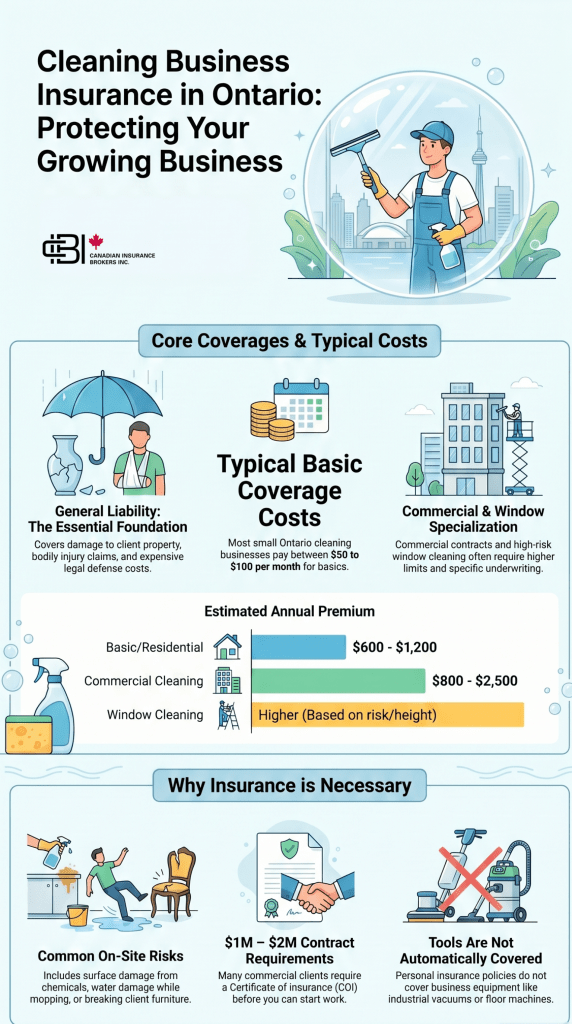
- Using cleaning products that damage surfaces
- Water damage during mopping or washroom cleaning
- Breaking fixtures, furniture, or appliances
- Losing keys or creating access issues
- Injuries that happen while on site
These situations are not unusual. What matters is who is responsible when they occur. That is where insurance becomes practical.
What Insurance Does a Cleaning Business Need?
Most cleaning businesses start with a core set of coverages and adjust as their work changes.
General Liability Insurance
This is the foundation of most policies. It typically covers:
- Damage to client property
- Bodily injury claims
- Legal defense costs
This is often required for both residential and commercial work.
Commercial Cleaning Insurance
Office and commercial cleaning usually involve more formal requirements.
This may include:
- Higher liability limits
- Proof of insurance
- Contract-based requirements
In cities like Toronto or Ottawa, this is often expected before work begins.
Window Cleaning Insurance
Window cleaning carries a higher level of risk.
This includes:
- Working at heights
- Use of ladders or lift equipment
- Increased injury exposure
This type of work often requires higher limits and more careful underwriting.
Equipment and Tools Coverage
Cleaning businesses rely on tools that are not covered under personal policies.
This includes:
- Vacuums and machines
- Floor equipment
- Portable tools and supplies
As the business grows, this becomes more important.
Cleaning Business Types (Home, Office, and Commercial)
Cleaning businesses often operate across multiple service types:
- Home cleaning: private residences and recurring clients
- Office cleaning: regular business environments and contracts
- Commercial cleaning: larger properties, retail, or managed spaces
- Window cleaning: exterior or higher-risk work
Many businesses in Ontario combine these services. The mix of work directly affects the level of risk and the insurance needed.
Cleaning Business Insurance Cost in Ontario
Cost is one of the first questions most business owners have, but it is often overestimated.
Typical ranges:
- Basic cleaning business insurance: $600 to $1,200 per year
- General liability insurance: $50 to $100 per month
- Commercial cleaning insurance: $800 to $2,500 annually
Several factors influence pricing:
- Type of cleaning work
- Revenue and size of the business
- Number of employees
- Contract requirements
- Location within Ontario
The more useful comparison is not just price, but the difference between a predictable cost and an unexpected claim.
Top Risks for Cleaning Businesses
Most insurance claims in the cleaning industry come from a few recurring issues. Here’s a simple breakdown of where problems usually happen.
Based on common claim patterns across cleaning businesses. Actual risk depends on your services, staff, and client environments.
How to Get Insurance for a Cleaning Business
Getting insurance usually follows a simple process:
- Identify your services (home, office, commercial, window)
- Understand where liability exists
- Review any contract requirements
- Start with liability coverage
- Add equipment or higher limits if needed
Get a quote to compare cleaning business insurance options based on your services and client type.
What Cleaning Business Owners Often Miss
Most problems do not come from having no insurance. They come from assumptions.
Common gaps include:
- Assuming small jobs carry little risk
- Assuming coverage applies broadly
- Assuming tools are automatically covered
- Overlooking legal costs
Even moderate claims can become expensive once legal fees are involved.
How Insurance Changes as You Grow
Cleaning businesses often grow quickly. Many contracts may require a certificate of insurance or COI listing $1 million or $2 million of commercial general liability (CGL). What starts as residential work can turn into office contracts or larger commercial jobs.
As this happens:
- Contracts become larger
- Clients expect formal coverage
- Hiring introduces new exposure
- Equipment value increases
Insurance should change along with the business.
Visual: Cleaning Business Insurance in Ontario
Why Work With James Inwood
Cleaning business insurance is not just about having a policy in place. It is about making sure the coverage reflects how the business actually operates.
James Inwood works with cleaning businesses across Ontario to review services, client types, and contract requirements, and align coverage accordingly.
Get a quote with James Inwood to review your cleaning business insurance.
Frequently Asked Questions
General liability insurance is usually the most important starting point for a cleaning business because it addresses the most common day-to-day risks. If damage happens inside a client’s property or someone claims injury connected to your work, this is often the coverage that responds first. It can also help with legal defense costs, which can become expensive even when the claim itself is not severe. For many cleaning businesses, it is the core policy that supports everything else.
Many cleaning businesses in Ontario pay somewhere between $600 and $1,200 per year for basic coverage, although the actual price can vary depending on the operation. Factors like revenue, number of employees, claims history, and whether the business performs residential or commercial work all affect pricing. Businesses taking on larger contracts or higher-risk services may pay more, especially if clients require higher liability limits. The best way to compare cost properly is to look at both price and what the policy actually includes.
Yes, commercial cleaning insurance is often different from basic small-business coverage because the work usually comes with more formal requirements. Commercial clients may ask for proof of insurance, higher liability limits, named additional insureds, or policy wording that aligns with their contract terms. The scale of the work may also increase the exposure, especially in offices, retail units, condo buildings, and managed properties. As a result, commercial cleaning insurance often needs to be structured more carefully than a basic residential cleaning setup.

James Inwood is an Ontario-based insurance broker who works with service businesses, including cleaning companies, contractors, and growing operations. He focuses on helping business owners understand how insurance works in real scenarios, where liability begins, and how coverage should evolve as the business grows.
James Inwood, Insurance Broker
RIBO licensed | LinkedIn

