

Accident Benefits in Ontario (2026 Guide)
We provide professional insurance guidance for businesses and individuals through a secure and confidential quote process designed to be clear, efficient, and easy to begin.
Locally established in Oakville, Ontario

Coverage designed to match your business needs

Insurance options reviewed across markets and emailed to you

Accident Benefits in Ontario (2026 Guide)

We provide professional insurance guidance for businesses and individuals through a secure and confidential quote process designed to be clear, efficient, and easy to begin.

Locally established in Oakville, Ontario

Coverage designed to match your business needs
Insurance options reviewed across markets and emailed to you
Accident benefits in Ontario are one of the most misunderstood parts of auto insurance. Most drivers know they have coverage, but few understand what it actually does until they need it.
After a collision, attention often goes straight to vehicle damage or liability. In reality, the more significant impact is personal. Injuries, time away from work, rehabilitation costs, and long-term recovery can create financial pressure that lasts well beyond the accident itself.
Across Ontario, accident benefits are designed to stabilize that situation. They provide support regardless of fault, helping individuals manage both the medical and financial consequences of an accident.
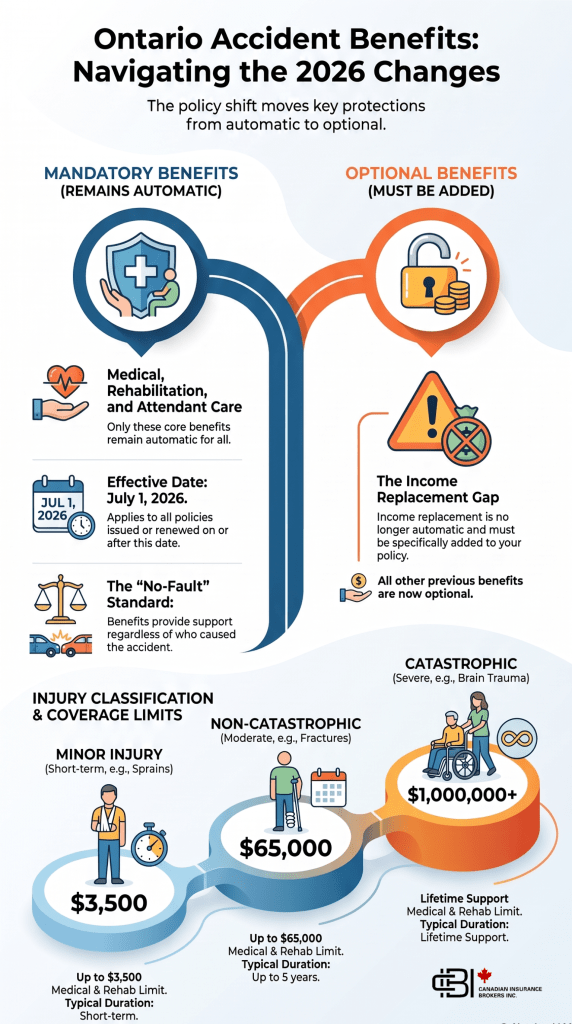
On July 1, 2026, Ontario updated its standard auto insurance policy (OAP 1). Medical, rehabilitation and attendant care benefits remain mandatory, while several other accident benefits are now optional. Understanding which benefits are included in your policy is more important than ever.
At a Glance: Accident Benefits in Ontario in 2026
- Ontario’s accident benefits rules changed on July 1, 2026.
- Medical, rehabilitation and attendant care benefits remain mandatory.
- Income replacement and several other accident benefits are now optional.
- Applies regardless of who caused the accident
- Governed by Ontario’s Statutory Accident Benefits Schedule (SABS)
- Coverage levels can be increased through optional benefits
- Claims rely heavily on documentation and medical evidence
- Plays a critical role in financial stability after an accident

What Are Accident Benefits in Ontario?
Accident benefits, often referred to as no-fault benefits, are included in every standard auto insurance policy in Ontario. They provide financial assistance if you are injured in a motor vehicle accident, regardless of fault.
This coverage is governed by Ontario’s Statutory Accident Benefits Schedule (SABS), which outlines eligibility, benefit limits and how accident benefit claims are processed.
Unlike liability insurance, which focuses on damages to others, accident benefits are designed to support your own recovery. This includes access to care, income replacement, and assistance with daily living if needed.
For policies issued or renewed under the updated OAP 1 beginning July 1, 2026, not every accident benefit is automatically included.
Why Accident Benefits Matter More Than Expected
Many drivers assume that provincial healthcare or workplace benefits will cover them after an accident. In practice, those systems often leave gaps.
For example, a driver in Mississauga involved in a collision may require physiotherapy, time off work, and ongoing treatment. While basic medical care may be covered, many rehabilitation costs and income losses are not.
That gap is where accident benefits insurance becomes essential.
Get a quote to review how your current policy handles income loss and recovery costs
Who Is Eligible for Accident Benefits in Ontario?
Eligibility is broader than most people expect. Accident benefits may apply to:
- Drivers listed on the policy
- Passengers in the insured vehicle
- Pedestrians or cyclists struck by a vehicle
- Household family members under the policy
Mandatory medical, rehabilitation and attendant care benefits may be available under Ontario’s priority rules. However, many of the newly optional benefits generally apply only to the named insured, their spouse, dependants and listed drivers.
Is Accident Benefits Mandatory in Ontario?
Yes, but only some accident benefits remain mandatory.
Medical, rehabilitation and attendant care benefits continue to be included in every Ontario auto insurance policy.
Beginning July 1, 2026, benefits such as income replacement, caregiver, housekeeping, death and funeral benefits became optional under the updated OAP 1.
Drivers should review their policy to understand which optional accident benefits have been selected.
What Does Accident Benefits Coverage Include?
Accident benefits are structured into several categories, each addressing a different part of recovery.
Mandatory Benefits
- Medical and Rehabilitation
- Attendant Care
Optional Benefits
- Income Replacement
- Non-Earner
- Caregiver
- Death & Funeral
Accident Benefits Coverage Levels in Ontario (2026)
| Injury Classification | Medical & Rehab | Attendant Care | Coverage Duration | Typical Scenario |
|---|---|---|---|---|
| Minor Injury | Up to $3,500 | Not included | Short-term | Sprains, strains, minor soft tissue injuries |
| Non-Catastrophic | Up to $65,000 combined | Included | Up to 5 years | Moderate injuries requiring ongoing treatment |
| Catastrophic | $1,000,000+ | Separate limits | Lifetime | Severe injuries such as brain trauma or paralysis |
How Accident Benefits Claims Work
After an accident, the process typically involves both medical and financial evaluation. Steps generally include:
- Reporting the accident to your insurer
- Completing required forms and documentation
- Undergoing medical assessments
- Submitting treatment plans and income verification
- Ongoing review by the insurer
Claims are evidence-based. The quality of documentation often determines how smoothly the process moves forward.
Accident Benefits Settlement in Ontario
In some cases, claims are resolved through a settlement rather than ongoing payments.
A settlement may be considered when:
- Long-term care needs are established
- There is a dispute over entitlement
- Both parties agree to resolve the claim
Settlement amounts vary depending on injury severity, financial impact, and supporting medical evidence.
Optional Accident Benefits in Ontario
Basic coverage does not always reflect real-world financial exposure. Following the July 1, 2026 OAP 1 changes, optional accident benefits now include both increased coverage limits and benefits that were previously included automatically, such as:
- Higher income replacement levels
- Increased medical and rehabilitation coverage
- Expanded attendant care benefits
For individuals in Ontario who rely on consistent income, these enhancements can be significant.
When Increased Accident Benefits Make Sense
Enhanced coverage is often considered in situations such as:
- Self-employed individuals
- High-income earners
- Families with dependents
- Individuals without disability coverage
In these cases, standard limits may not adequately protect against income disruption.
Get a quote to compare optional accident benefits and see how increased limits could impact your protection after a serious accident.
What Is Not Covered
Accident benefits have limitations. Common exclusions include:
- Injuries unrelated to the accident
- Claims without sufficient documentation
- Certain unapproved treatments
Understanding these limits is key when evaluating your policy.
Real-World Insight: The Cost of Injury Claims
In Ontario, injury-related claims represent a significant portion of total auto insurance costs. Even moderate injuries can result in:
- Thousands of dollars in rehabilitation expenses
- Extended time away from work
- Ongoing treatment requirements
This highlights an important point. The financial impact of an accident often extends far beyond the initial event.
After the July 1, 2026 changes, drivers should also consider whether mandatory benefits alone provide enough financial protection or whether optional accident benefits better reflect their income and family responsibilities.
How Accident Benefits Play Out Across Ontario
While coverage is standardized, real-world outcomes can vary by location.
- Toronto: Higher traffic density increases accident frequency and claim complexity.
- Mississauga and Brampton: Heavy commuter traffic can lead to more frequent injury claims.
- Oakville and Burlington: Access to healthcare providers can influence recovery timelines.
- Halton Region: Longer commuting distances may impact return-to-work timelines.
Why Many Drivers Are Underinsured
Even with mandatory coverage, many individuals are underinsured. Common gaps include:
- Relying on default limits without review
- Not accounting for income growth
- Overlooking optional benefits
- Assuming workplace coverage is sufficient
- Assuming income replacement is still automatically included
- Not reviewing policy changes after July 1, 2026
These gaps often become clear only after a claim occurs.
Accident Benefits in Oakville
While accident benefits are standardized across Ontario, local driving conditions can influence how often residents need to rely on them. Oakville's busy commuter corridors see thousands of vehicles every day, making understanding your coverage an important part of financial protection.
2024
Oakville Collision Snapshot
Oakville recorded 1,202 collisions on Halton Regional roads in 2024, representing approximately 34% of all regional-road collisions in Halton. Even relatively minor crashes can lead to rehabilitation costs, missed work and other expenses that accident benefits are designed to help cover.
Glen Abbey
Many residents commute via Third Line, Upper Middle Road and Bronte Road to access Highway 403 and the QEW, resulting in regular exposure to busy commuter traffic.
North Oakville
One of Oakville's fastest-growing communities, with many daily trips along Dundas Street and Trafalgar Road, two of the town's busiest arterial routes.
Bronte
Bronte residents frequently travel along Bronte Road and the QEW when commuting to Burlington, Mississauga and Toronto for work or business.
Whether you're commuting locally or across the GTA, accident benefits can help eligible drivers and passengers with medical treatment, rehabilitation, attendant care and other recovery-related expenses following a motor vehicle accident.
Accident Benefits vs Group Personal Accident Insurance
Group personal accident insurance may provide lump-sum payments, but it does not replace the structured, ongoing support provided by accident benefits.
Accident benefits are designed to respond in real time, covering treatment and income loss as they occur.
Why This Coverage Matters
Accident benefits become most important after the accident itself, when uncertainty begins to build. Recovery timelines may be unclear. Expenses start to accumulate. Income may be interrupted.
This coverage provides stability during that period, allowing individuals to focus on recovery rather than immediate financial pressure.
The updated OAP 1 gives Ontario drivers more choice, but it also places greater responsibility on policyholders to understand what coverage they have selected.
Visual: Accident Benefits in Ontario (Your 2026 Essential Guide)
Why Work With James Inwood
James Inwood is an insurance broker based in Oakville, working with individuals and business owners across Ontario.
His approach focuses on how coverage performs in real situations. Accident benefits are not just a line item in a policy. They are a critical part of financial protection that needs to align with how people live and work.
Rather than relying on standard limits, James works with clients to understand exposure, income structure, and recovery risks. This allows coverage to be structured in a way that reflects real-world scenarios, not just assumptions.
Get a quote or book a quick call with James Inwood to review your current coverage and identify any gaps.

Frequently Asked Questions
If your benefits reach their limit before recovery is complete, you may need to rely on private insurance, workplace disability coverage, or pursue additional compensation through legal channels.
In most cases, yes. You can select your own healthcare providers, but treatment plans typically need to be approved by your insurer.
Accessing accident benefits does not automatically increase premiums, but overall claims history and fault may still influence future rates.
Some benefits can begin within weeks if documentation is complete, but timelines vary depending on claim complexity.
Yes, but they must provide financial documentation such as tax returns and business records to support their claim.
Not automatically. For policies issued under the July 1, 2026 OAP 1, income replacement benefits are optional and must be selected. Existing policies may continue previous coverage unless changes are made at renewal.
Medical, rehabilitation and attendant care benefits remain mandatory under Ontario auto insurance. Other accident benefits, including income replacement and caregiver benefits, are optional.

James Inwood is a Canadian insurance advisor specializing in commercial and personal insurance for contractors, trades, and small business owners across Ontario. Based in Oakville, he helps clients understand how insurance responds in real situations, from liability to income protection and accident-related risks.
James Inwood, Insurance Broker
RIBO licensed | LinkedIn