





Commercial Property Insurance in Ontario
We provide professional insurance guidance for businesses and individuals through a secure and confidential quote process designed to be clear, efficient, and easy to begin.
Locally established in Oakville, Ontario
Coverage designed to match your business needs
Insurance options reviewed across markets and emailed to you
Commercial Property Insurance in Ontario
We provide professional insurance guidance for businesses and individuals through a secure and confidential quote process designed to be clear, efficient, and easy to begin.
Locally established in Oakville, Ontario
Coverage designed to match your business needs
Insurance options reviewed across markets and emailed to you

For most businesses, the physical side of operations is easy to overlook until something goes wrong. Buildings, equipment, and inventory are part of daily operations, but when they are damaged, the impact is immediate.
Across Ontario, from Toronto and North York to Oakville, Burlington, Mississauga, and Hamilton, businesses rely on physical spaces to operate. A fire, break-in, or water loss can stop operations instantly while expenses continue.
Commercial property insurance is designed to manage that risk. It provides financial support when physical assets are damaged, helping businesses recover and move forward without absorbing the full cost of a loss.
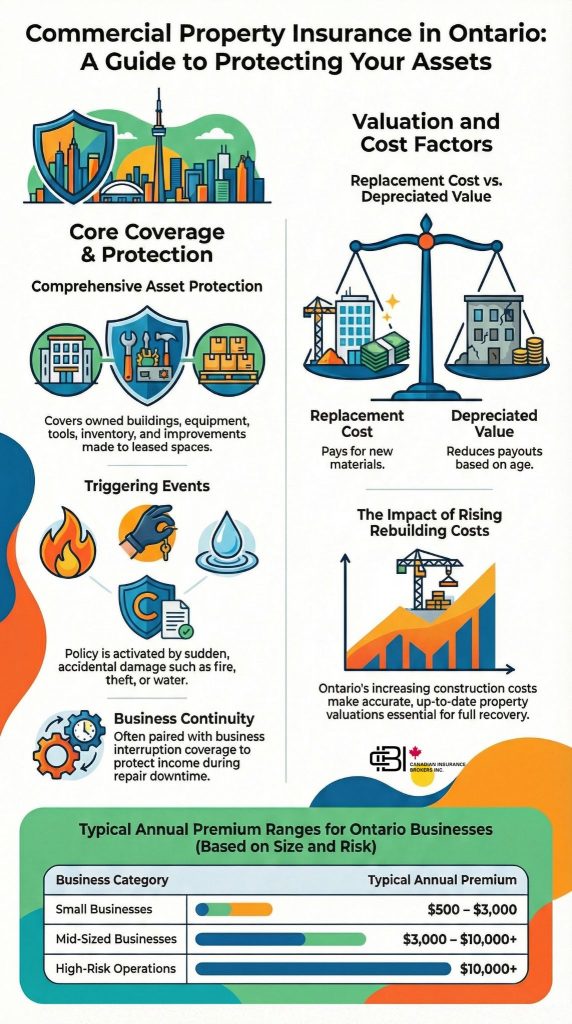
Quick Overview: Commercial Property Insurance in Ontario
Commercial property insurance focuses on protecting the physical side of a business, but the details depend on how the policy is structured.
- Protects buildings, equipment, and inventory
- Covers risks like fire, theft, and certain types of water damage
- Typically part of a broader commercial insurance policy
- Can be structured based on replacement cost or depreciated value
- Often paired with income protection through business interruption coverage
What This Coverage Actually Does
At a basic level, commercial property insurance protects the assets a business relies on to operate.
That includes the building itself if it is owned, along with everything inside that supports daily operations. For businesses leasing space, coverage applies to contents and improvements made to that space.
The key idea is simple. If physical damage prevents the business from operating as expected, this coverage helps repair or replace what was lost.
When Coverage Applies
Commercial property insurance is triggered by physical damage caused by a covered event.
This might include a fire in a retail unit in Toronto, water damage in an office in Oakville, or theft of tools from a contractor’s shop in Burlington.
Once the damage occurs, the insurer evaluates the loss and determines the cost to repair or replace the affected property. The outcome depends heavily on how the policy was structured before the loss.
What Is Typically Included
While coverage varies, most policies are built around the same core components:
- The structure of the building, if owned
- Equipment, machinery, and tools
- Inventory and materials
- Furniture, fixtures, and office contents
- Improvements made to leased premises
Some policies also extend to equipment breakdown or are paired with business interruption coverage to address income loss during downtime.
Get a quote to compare coverage options based on your property, assets, and how your business operates.
Different Ways This Coverage Is Structured
Not every business needs the same type of property coverage.
A business that owns its building will have different requirements than one leasing space in Toronto or Vaughan. Landlords who rent out commercial units face a different type of exposure, especially when multiple tenants are involved.
Vacant buildings are another category entirely. When a property is unoccupied, the risk profile changes, and coverage must be structured accordingly.
These differences are not always obvious upfront, but they become important when a claim is filed.
How Insurers Determine Coverage Amounts
Commercial property insurance is based on what it would cost to rebuild and replace everything needed to operate the business.
This includes construction costs, equipment values, and inventory levels. In Ontario, rebuilding costs have increased significantly in recent years, which makes accurate valuation more important than ever.
If coverage limits are set too low, there may be a gap between what is insured and what it actually costs to recover.
Get a quote or review your commercial property insurance based on your building, assets, and replacement costs.
Replacement Cost vs Depreciated Value
One of the most important decisions in any property policy is how assets are valued.
Replacement cost coverage pays to replace damaged property with new materials of similar kind and quality, without deducting for depreciation.
Depreciated value, often referred to as actual cash value, reduces the payout based on the age and condition of the asset.
Why This Distinction Matters
With rising construction and material costs across Ontario, this difference can be significant.
A policy based on depreciated value may not provide enough to fully rebuild or replace equipment. This can leave businesses covering part of the loss themselves.
This is why valuation is not just a technical detail. It directly affects how well the policy performs when it is needed.
Commercial Property Insurance Cost in Ontario
The cost of commercial property insurance depends on the size of the business, the type of property, and how the policy is structured.
For many businesses in Ontario, this coverage is included within a broader commercial insurance policy and falls within a predictable range.
Typical range:
- Small businesses: $500 to $3,000 annually
- Mid-sized businesses: $3,000 to $10,000+
- Larger or higher-risk operations: $10,000+ depending on property value and exposure
What matters most is not just the premium, but whether the coverage reflects the actual cost to rebuild and replace your assets.
Get a quote and review options based on your property type, location, and overall risk exposure.
What the Claims Process Looks Like
When damage occurs, the claims process focuses on both the cause of loss and the value of what was affected.
Insurers typically inspect the property, determine the extent of damage, and assess the cost to repair or replace the affected assets.
Businesses may be required to provide supporting documentation such as:
- Photos of the damage
- Equipment or inventory lists
- Repair estimates
Clear documentation helps ensure the process moves efficiently and reduces delays.
Where Coverage Has Limits
Commercial property insurance is designed for sudden and accidental damage. It does not cover every type of risk.
Common exclusions include:
- Gradual wear and tear or maintenance issues
- Flooding or earthquakes unless specifically added
- Cyber incidents
- Utility outages originating off-site
Understanding these limits is important when structuring coverage.
How Commercial Property Insurance Supports Business Continuity
Property damage occurs
Fire, water, theft
Insurance responds
Repair or replace assets
Business recovers
Operations resume faster
Where Coverage Gaps Often Happen
Many businesses have commercial property insurance, but the coverage does not always reflect their current exposure.
As operations grow, equipment is added, and inventory levels change, policies are not always updated. At the same time, rebuilding costs continue to increase.
These gaps often only become visible after a loss has occurred.
The Real Impact of Property Damage on a Business
The importance of commercial property insurance becomes clear in the period after a loss.
Repairs take time, costs can shift, and operations may be disrupted longer than expected. Without proper coverage, these challenges can quickly affect the financial stability of a business.
This coverage provides a level of predictability during that period, allowing business owners to focus on recovery.
Visual: Commercial Property Insurance in Ontario
Working With James Inwood
James Inwood is an insurance broker based in Oakville who works with business owners across Halton Region and Ontario.
He focuses on how businesses actually operate and how risk develops over time. Rather than relying on standard templates, coverage is aligned with real-world exposure.
Get a quote or book a quick call with James Inwood to review your current coverage and identify any gaps.
Frequently Asked Questions
It is not legally required, but it is often required by landlords or lenders and is commonly included in commercial insurance policies.
Yes. Policies should be reviewed regularly to reflect changes in property value, equipment, and operations.
Yes. It can cover your contents, equipment, and any improvements made to the space.
You should consider rebuilding costs, the value of your assets, and how long it would take to recover after a loss.

James Inwood supports Ontario business owners with commercial property insurance guidance
James Inwood is a Canadian insurance advisor specializing in commercial insurance for contractors, trades, and small business owners across Ontario. Based in Oakville, he works with businesses to help them understand how property insurance connects to operations, asset protection, and long-term risk management.
He advises clients across Ontario with a focus on how commercial spaces are actually used, how property risk develops over time, and how coverage should be structured to respond effectively when a loss occurs.
James Inwood, Insurance Broker
RIBO licensed | LinkedIn

