
Food Truck Insurance in Ontario
We provide professional insurance guidance for businesses and individuals through a secure and confidential quote process designed to be clear, efficient, and easy to begin.

Locally established in Oakville, Ontario

Coverage designed to match your business needs

Insurance options reviewed across markets and emailed to you

Food Truck Insurance in Ontario

We provide professional insurance guidance for businesses and individuals through a secure and confidential quote process designed to be clear, efficient, and easy to begin.

Locally established in Oakville, Ontario

Coverage designed to match your business needs
Insurance options reviewed across markets and emailed to you
Operating a food truck combines the risks of running both a restaurant and a commercial vehicle. Every day, food truck owners rely on expensive cooking equipment, refrigeration, propane systems, inventory, and their vehicle to serve customers at festivals, private events, construction sites, breweries, and public spaces.
Whether you operate a single food truck, concession trailer, or a fleet of mobile food vendors, choosing the right insurance can help protect your investment and keep your business moving.
At a Glance: Food Truck Insurance
- Designed for food trucks, food trailers, concession trailers, and other mobile food vendors
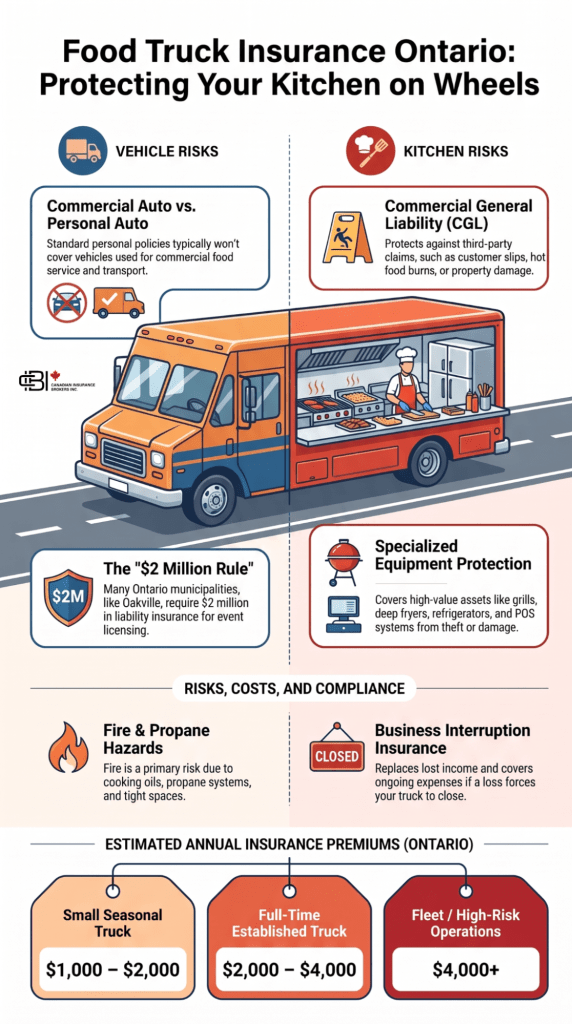
- Commercial general liability helps protect against customer injuries and property damage
- Commercial auto insurance protects the truck while travelling between locations
- Equipment insurance may help cover grills, fryers, refrigerators, generators, and POS systems
- Business interruption insurance may help replace lost income after an insured loss
- Fire and propane-related risks are important considerations for mobile kitchens
- Coverage can often be customized to match your menu, vehicle, and operating locations
What Is Food Truck Insurance?
Food truck insurance is a specialized commercial insurance package designed for businesses that prepare and sell food from a mobile vehicle or trailer.
Unlike a traditional restaurant, food trucks combine commercial cooking operations with daily driving, creating additional risks that standard business insurance often does not cover.
Depending on your business, a policy may include:
- Commercial General Liability Insurance
- Commercial Auto Insurance
- Equipment Insurance
- Commercial Property Insurance
- Business Interruption Insurance
- Crime Coverage
- Cyber Insurance
The right policy depends on your vehicle, cooking equipment, annual revenue, operating locations, and whether you attend festivals, private events, or construction sites.
Do Food Trucks Need Insurance?
Most food truck operators require insurance before participating in festivals, corporate events, breweries, or municipal events. Insurance becomes particularly important because food truck businesses face multiple risks every day.
Examples include:
- A customer slips while waiting in line.
- A propane leak causes a fire.
- Hot food burns a customer.
- A generator damages nearby property.
- A commercial vehicle is involved in a collision.
- Refrigeration fails and food inventory spoils.
- Expensive cooking equipment is stolen overnight.
- Severe weather forces an event to close early.
Even experienced operators cannot eliminate every risk.
Did you know? Food truck operators attending special events in Oakville must generally obtain a Special Event Refreshment Vehicle Licence, submit proof of at least $2 million in public liability insurance, and meet applicable Halton Region Public Health requirements before serving food.
Who Needs Food Truck Insurance?
Food truck insurance can benefit many mobile food businesses throughout Ontario.
Examples include:
- Food trucks
- Food trailers
- Coffee trucks
- Ice cream trucks
- BBQ trailers
- Taco trucks
- Burger trucks
- Pizza trucks
- Dessert trailers
- Beverage trucks
- Mobile catering businesses
- Festival food vendors
- Farmers’ market vendors
- Mobile concession businesses
Whether you operate seasonally or year-round, insurance should reflect the services you provide and the locations where you operate.
Get a quote for food truck insurance before your next event.
What Insurance Does a Food Truck Need?
Every business is different, but most food truck operators should consider several core types of coverage.
Commercial General Liability Insurance
Commercial general liability insurance helps protect your business if a third party is injured or their property is damaged because of your operations.
Many event organizers require proof of liability insurance before allowing food trucks to participate.
Commercial Auto Insurance for Food Trucks
Unlike a personal vehicle, a food truck is used for commercial purposes and usually requires commercial automobile insurance.
This coverage may help protect against losses involving:
- Vehicle collisions
- Damage to another person’s vehicle
- Injury claims
- Theft
- Vandalism
- Certain weather-related losses
Coverage should reflect how your truck is actually used, including travel to festivals, private catering events, breweries, construction sites, and recurring service locations.
Food Truck Liability Insurance
Food truck liability insurance generally combines commercial general liability with other coverages appropriate for your operations.
Depending on your business, it may help respond to claims involving:
- Customer injuries
- Property damage
- Product-related claims
- Completed operations
- Legal defence costs for covered claims
If you employ staff, additional coverages such as workers’ compensation obligations and employer-related protections may also need to be considered.
Food Truck Fire Insurance
Fire is one of the most significant risks facing mobile kitchens.
Cooking oils, propane cylinders, electrical systems, generators, grills, fryers, and ventilation equipment all increase the potential for fire damage.
Food truck fire insurance may help cover damage caused by an insured fire to:
- The food truck
- Cooking equipment
- Refrigeration units
- Inventory
- Serving equipment
- Certain permanently attached fixtures
Routine equipment inspections, fire suppression systems, and proper propane maintenance can help reduce risk, but insurance remains an important part of protecting your investment.
After an Accident or Fire
1. Protect People First
Move customers and staff away from the danger. Call 911 immediately if there is a fire, propane leak, or serious collision.
2. Shut Down Equipment
If it is safe, turn off propane cylinders, generators, cooking appliances, and electrical systems to prevent additional damage.
3. Document the Scene
Take photos of the truck, cooking equipment, surrounding property, and any damage before cleanup begins.
4. Contact Your Insurance Broker
Report the claim as soon as possible and keep receipts for temporary repairs or emergency expenses.
Food Truck Equipment Insurance
The equipment inside your food truck is often one of your biggest investments. From grills and fryers to refrigerators and point-of-sale systems, a single loss could leave your business unable to operate.
Food truck equipment insurance helps protect the tools you rely on every day if they’re damaged by a covered event such as fire, theft, vandalism, or certain accidental losses.
Equipment that may be covered includes:
- Flat-top grills
- Deep fryers
- Refrigerators
- Freezers
- Pizza ovens
- BBQ smokers
- Coffee machines
- Ice cream machines
- Beverage dispensers
- Generators
- Point-of-sale systems
- Prep tables
- Small kitchen appliances
If you’ve recently upgraded your equipment, review your coverage regularly to ensure your insured values reflect current replacement costs.
Food Truck Property Insurance
Although your business is mobile, you may still need property insurance.
Food truck property insurance can help protect business property stored inside your truck, trailer, commissary kitchen, or approved storage location.
Depending on your policy, coverage may include:
- Food inventory
- Cooking utensils
- Small appliances
- Packaging supplies
- Serving equipment
- Tables and tents
- Outdoor signage
- Cash registers
- Portable generators
If your truck is broken into overnight or equipment is damaged during a covered loss, property insurance may help pay for repairs or replacement.
Food Truck Inventory Coverage
Fresh ingredients are your business.
Whether you operate a taco truck, coffee truck, burger trailer, or dessert truck, inventory can represent thousands of dollars in food at any given time.
Food truck insurance may help cover inventory damaged by an insured event, including:
- Fire
- Smoke damage
- Refrigeration failure (where covered)
- Theft following a covered loss
- Certain water damage
Keeping accurate inventory records and receipts can help simplify the claims process if a loss occurs.
Business Interruption Insurance for Food Trucks
If your truck cannot operate after an insured loss, your expenses don’t stop. Loan payments, employee wages, rent for commissary kitchens, supplier invoices, and other operating costs may continue even while your business is closed.
Business interruption insurance may help cover:
- Lost business income
- Ongoing operating expenses
- Employee payroll
- Temporary relocation costs
- Some extra expenses needed to resume operations
For many food truck businesses, missing just one major festival or weekend event can result in significant lost revenue.
Did you know? Canada’s food service industry contributes more than $120 billion annually to the Canadian economy and employs over 1.2 million people, making it one of the country’s largest private-sector employers.
Where Food Truck Risks Build During the Day
A food truck’s exposure changes from loading to overnight storage. Select a stage to explore a common operational risk.
Temperature control starts before service
Loading delays, open cooler doors, or insufficient refrigeration can affect ingredients before the truck reaches its destination.
Record refrigerator temperatures before departure and keep receipts, inventory lists, and maintenance records together.
Food Truck Insurance Cost
Food truck insurance costs vary depending on your vehicle, equipment, annual revenue, operating locations, claims history, and the coverages you choose.
While every business is different, many Ontario food truck owners can expect premiums within the following ranges.Typical factors that affect your premium include:
- Small seasonal food truck: approximately $1,000–$2,000/year
- Established full-time food truck: approximately $2,000–$4,000/year
- Multiple trucks or higher-risk operations: $4,000+ per year, depending on the vehicle, equipment, and coverage requirements.
Because every mobile food business operates differently, the most accurate way to understand your cost is to request a personalized food truck insurance quote.
What Food Truck Insurance Doesn't Cover
Every insurance policy contains exclusions.
Common exclusions may include:
- Wear and tear
- Mechanical breakdown
- Lack of maintenance
- Intentional damage
- Illegal business activities
- Undisclosed vehicle modifications
- Normal deterioration
- Driving without proper licensing
Review your policy carefully with your insurance broker so you understand what is and isn’t covered.
Case Study: Fire at Food Truck
In October 2023, the Tiki Taka food truck exploded at Muskoka Bay Park in Gravenhurst, Ontario. The truck was unoccupied at the time, and no injuries were reported. The explosion destroyed the food truck and scattered debris across the surrounding area, prompting an investigation by local fire officials, Ontario Provincial Police, and the Office of the Fire Marshal.
The owners later said they hoped to rebuild after losing their food truck business. The incident demonstrates how a major fire or explosion can result in the sudden loss of a food truck and disrupt business operations. Appropriate food truck insurance, including coverage for the vehicle and business equipment, can help protect owners financially after a covered loss.
Oakville Event and Visitor Statistics
Oakville’s strong event culture and busy downtown create opportunities for food truck operators serving festivals, community gatherings, markets, and other local events. Recent Town and Downtown Oakville research provides a clearer picture of local event interest and visitor activity.
- 79% of respondents to Oakville’s community survey agreed or strongly agreed that special events help them feel connected to their community. The Town’s Special Events Plan was informed by a community survey that received 1,151 responses.
- 44% of community survey respondents selected food and beverage events as a type of event the Town should focus on supporting or delivering in the future.
- 69% of respondents selected arts, music, and performance events as a priority for future Town support, while 43% selected holiday and seasonal events. These types of gatherings can create opportunities for food and beverage vendors.
- Downtown Oakville recorded 9.2 million visits in 2025, up from 8.8 million in 2024, according to Downtown Oakville’s Environics traffic data.
- Saturday is Downtown Oakville’s busiest day of the week, accounting for 18% of visits, followed by Sunday at 16%.
For food truck operators, this combination of community interest in special events, demand for food and beverage programming, and significant downtown visitor traffic can create valuable opportunities to serve customers at local events and high-traffic periods.
Why Work With James Inwood
Every food truck business operates differently. Some serve local lunch crowds, while others travel across Ontario attending festivals, weddings, breweries, and private events.
James Inwood Insurance can help you compare coverage for your business, including commercial auto insurance, liability insurance, equipment coverage, property insurance, and business interruption insurance.
Whether you’re launching your first truck or expanding your fleet, we’ll help you find coverage that fits your business.
Get a quote or book a meeting with James Inwood to review your food truck insurance options.
Frequently Asked Questions
Yes. Seasonal food truck businesses can often be insured based on how and when they operate. Your insurer may ask about the months you are active, where the truck is stored during the off-season, and whether equipment remains inside the vehicle while it is not in use.
It can, provided those activities are disclosed to your insurer. If you cater weddings, corporate functions, private parties, festivals, or other off-site events, make sure your policy accurately reflects those operations. Some venues may also request a certificate of insurance before allowing you to attend.
Coverage for rented, leased, or borrowed equipment depends on the policy. If you regularly rent generators, refrigeration units, tents, cooking equipment, or other items, ask whether those items are automatically covered or need to be specifically added.
They can be. A concession or food trailer does not have its own engine, so the insurance structure may differ from that of a motorized food truck. You may need coverage for the trailer itself, its contents, your business liability, and the vehicle used to tow it.
Coverage may extend to different locations, but insurers need an accurate picture of where you normally operate. Regular travel between municipalities, long-distance events, overnight trips, or operations outside Ontario should be discussed with your broker.

James Inwood is an Ontario-based insurance broker who works with food trucks, restaurants, mobile vendors, and other hospitality businesses across the province. He helps clients review commercial liability, commercial auto, equipment, property, business interruption, and other coverage options designed to protect mobile food operations from covered losses.
James Inwood, Insurance Broker
RIBO licensed | LinkedIn