

What Is a Sole Proprietorship? A Guide for Ontario Business Owners
We provide professional insurance guidance for businesses and individuals through a secure and confidential quote process designed to be clear, efficient, and easy to begin.

Locally established in Oakville, Ontario

Coverage designed to match your business needs

Insurance options reviewed across markets and emailed to you

What Is a Sole Proprietorship? A Guide for Ontario Business Owners

We provide professional insurance guidance for businesses and individuals through a secure and confidential quote process designed to be clear, efficient, and easy to begin.

Locally established in Oakville, Ontario

Coverage designed to match your business needs
Insurance options reviewed across markets and emailed to you

A sole proprietorship is the simplest way to start a business in Ontario. It allows one individual to operate under their own name or a registered business name without creating a separate legal entity. This structure is widely used across Toronto, Oakville, Ajax, and surrounding Ontario cities, especially among contractors, trades, and independent professionals who want to get started quickly.
That simplicity is what makes it appealing, but it also defines the risk. Because there is no legal separation between you and your business, everything flows directly through to you. Income, contracts, and liabilities are all personal. From an insurance perspective, this is the most important detail to understand, because it shapes how exposure works and why coverage becomes essential early on.
At a Glance: Sole Proprietorships in Ontario
Sole proprietorships are easy to set up, but they come with important trade-offs that affect both finances and risk.
- You and your business are legally the same entity
- Setup is quick and low cost in Ontario
- Income is taxed as personal income
- Common across trades and service businesses
- Personal assets are exposed to business risk
- Insurance often becomes the main form of protection
Understanding these fundamentals early helps avoid surprises later, especially when taking on clients or signing contracts.

Sole Proprietorship Meaning & Definition
A sole proprietorship is a business structure where one individual owns and operates the business, and there is no legal separation between the owner and the business itself. In Ontario, this means the owner is personally responsible for all income, debts, and liabilities tied to the business.
Unlike a corporation, a sole proprietorship does not create a separate legal entity. The business and the individual are treated as the same for legal and tax purposes. This is why income is reported on a personal tax return and why any financial or legal issues connected to the business can directly affect personal assets.
How Sole Proprietorships Work in Ontario
A sole proprietorship does not create a separate legal structure. Instead, the business operates as an extension of the individual. This means that any revenue earned is treated as personal income, and any obligations or liabilities are also tied directly to the owner.
In real-world terms, this structure is common across Ontario. A contractor working on a home in Oakville, a consultant advising clients remotely, or a tradesperson completing service calls in Burlington may all operate as sole proprietors. The business may have a name, branding, and clients, but legally it is still the individual behind it.
This direct connection is what makes the structure efficient, but it also means that risk is not contained within the business. Every project, contract, or interaction carries potential exposure that extends beyond the work itself.
Insurance for Sole Proprietorships
One of the most important aspects of a sole proprietorship is how risk is handled. Because there is no legal separation between the business and the individual, insurance becomes a key part of protecting both business operations and personal finances.
Unlike corporations, which have some level of legal separation, sole proprietors rely more directly on insurance to manage exposure. This is especially relevant when working with clients, entering contracts, or operating in environments where property damage or liability claims are possible.
In Ontario, many clients, landlords, and contractors require proof of insurance before work begins. Even for smaller projects, having coverage in place helps ensure that unexpected situations do not become personal financial issues.
Advantages of a Sole Proprietorship
The main advantage of a sole proprietorship is how accessible it is. Most business owners can set up and begin operating with minimal cost and administrative effort. This makes it a practical choice for individuals who want to start earning income quickly or test a business idea without committing to a more complex structure.
There is also complete control over decision-making. Without partners or shareholders, you can adapt your services, pricing, and operations as needed. This flexibility is especially valuable in service-based businesses where responsiveness can make a difference.
Another benefit is simplicity in tax reporting. Business income is included on your personal tax return, which avoids separate corporate filings. While this works well early on, it can become less efficient as income increases, which is why many business owners eventually revisit their structure.
Disadvantages of a Sole Proprietorship
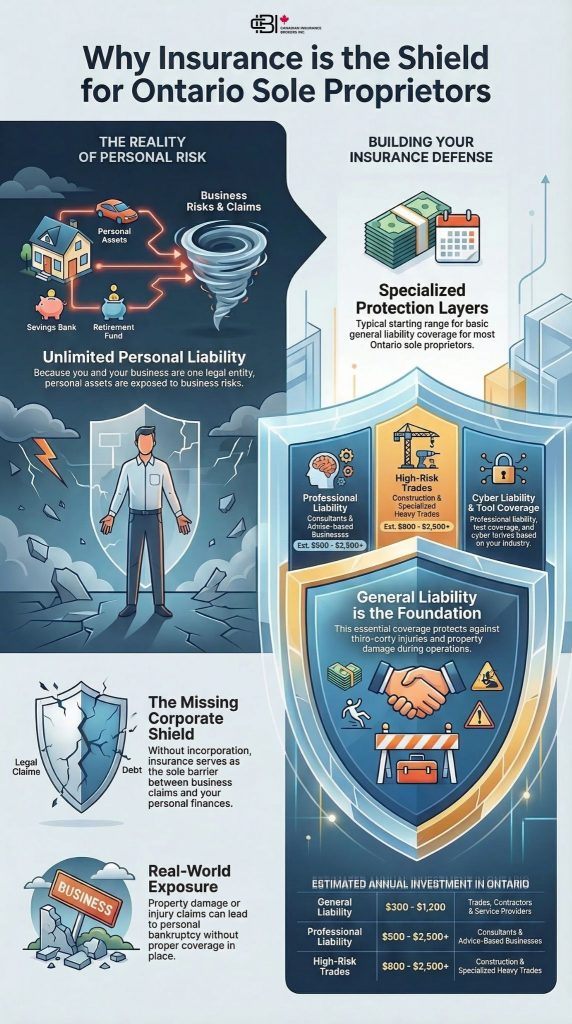
The most important drawback is unlimited liability. Because the business and the individual are legally the same, any financial or legal issue tied to the business becomes personal. This includes claims related to property damage, injury, or professional mistakes.
There are also limitations as the business grows. Larger clients and contracts may require higher levels of coverage or prefer working with incorporated entities. In some cases, remaining a sole proprietor can limit access to opportunities or financing.
Perception can also play a role. In competitive markets like Ontario, clients may compare multiple providers, and business structure can influence how professionalism or stability is viewed. While this does not define the quality of work, it can affect how a business is positioned.
Sole Proprietorships vs Corporations in Ontario
The decision between a sole proprietorship and a corporation often comes down to balancing simplicity with protection. A sole proprietorship is easier to manage, while a corporation creates a separate legal entity that can limit personal liability in certain situations.
From an insurance perspective, this distinction matters but is often misunderstood. Incorporation does not replace insurance. It adds a layer of separation, but risk still exists and must be managed. Sole proprietors rely more directly on insurance as their primary protection, while corporations use it alongside their legal structure.
Many business owners in Ontario start as sole proprietors and transition to a corporation as their revenue grows or their work involves larger projects.
How to Register a Sole Proprietorship in Ontario
Registering a sole proprietorship in Ontario is a straightforward process that can usually be completed online. If you are operating under a name other than your legal name, registration is required and results in a Master Business Licence.
The process typically involves:
- Choosing and checking your business name
- Registering through ServiceOntario
- Obtaining your licence
- Registering for HST if required
Once registration is complete and you begin working with clients, insurance often becomes part of the conversation. Many business owners look at coverage at this stage to ensure they are properly set up before taking on projects.
Get a quote to compare options based on your work and risk level.
Sole Proprietorship Taxes in Ontario
Taxes for a sole proprietorship are filed as part of your personal income tax return. Business income is added to your total income and taxed at your personal rate. This simplifies the process but can lead to higher tax obligations as earnings increase.
You are also responsible for tracking expenses and registering for HST once your revenue exceeds $30,000. Many business owners in Ontario find that tax planning becomes more important as their business grows, especially when comparing the benefits of incorporating.
Main Types of Business Ownership in Ontario
| Business Structure | Ownership | Legal Status | Liability | Tax Treatment | Best Fit |
|---|---|---|---|---|---|
| Sole Proprietorship | One owner | Not separate from the owner | Unlimited personal liability | Business income reported on the owner’s personal tax return | Simple startups, freelancers, contractors, and small service businesses |
| Partnership | Two or more owners | Generally not separate in the same way as a corporation | Partners can be personally liable depending on the partnership structure | Income is allocated to partners and reported through their tax filings | Businesses started with one or more co-owners |
| Corporation | One or more shareholders | Separate legal entity | Limited liability in many cases | Corporation files its own tax return | Growing businesses, higher-risk operations, and owners wanting more separation |
| Cooperative | Owned by members | Separate legal entity | Depends on the co-op structure | Can vary based on setup and rules | Member-owned organizations focused on shared benefit |
Why Insurance Matters for Sole Proprietors
The structure of a sole proprietorship makes insurance a central part of risk management. Because there is no separation between personal and business liability, any claim can directly affect your personal finances.
This becomes relevant in everyday situations. A contractor may accidentally damage a client’s property, a visitor could be injured on-site, or a consultant may face a claim related to advice or services provided. Even when claims are resolved, legal costs alone can be significant.
In Ontario, where property values and project sizes are often higher, the financial impact of these situations can be amplified. This is why many clients require proof of insurance before work begins. It is not just a formality, but a way to ensure that risk is properly managed.
Types of Insurance for Sole Proprietorships
Most sole proprietors start with general liability insurance, which covers third-party injury and property damage. This is often considered the foundation of business coverage, particularly for trades and contractors.
Additional coverage depends on the nature of the business:
- Professional liability for advice or service-related claims
- Tools and equipment coverage for trades
- Commercial property for business assets
- Business interruption for lost income
- Cyber liability for digital risks
If you operate independently, you may also want to review our guide on insurance for freelancers to better understand your coverage needs.
Get a quote and review coverage options based on your business type.
How Much Is Insurance for a Sole Proprietorship?
Insurance costs vary based on the type of business, but most sole proprietors in Ontario fall within a predictable range.
- Basic liability coverage: $300 to $1,200 per year
- Professional liability: $500 to $2,500+ per year
- Contractors and higher-risk trades: often $800 to $2,500+ annually
The exact cost depends on factors like industry, revenue, and coverage limits. In Ontario, higher property values and project sizes can influence both required coverage and pricing.
What matters most is not just the premium, but the level of protection. A single claim can exceed these costs many times over, which is why insurance is often viewed as a foundational part of running a business.
Visual: Why Insurance is the Shield for Ontario Sole Proprietors
Working With James Inwood
James Inwood is an insurance broker based in Oakville who works with sole proprietors and small business owners across Ontario. He focuses on how businesses actually operate and how risk shows up in real situations.
Rather than using generic policies, James aligns coverage with the work being done, reviewing contracts and identifying exposure as businesses grow.
For sole proprietors, this is especially important since liability is personal. The right insurance structure can make a meaningful difference.
Get a quote or book a quick call to review your options.
Frequently Asked Questions
Yes, if you use your exact legal name, registration may not be required. Using a business name does require registration.
In many cases, especially in trades and contracting, clients will require proof of insurance before work begins.
Most personal home policies exclude business activities, which means separate coverage is usually needed.
You are personally responsible for all costs related to a claim, including legal fees and damages.
Yes, many business owners start as sole proprietors and incorporate as their business grows.


James Inwood is a Canadian insurance advisor specializing in commercial insurance for contractors, trades, and small business owners across Ontario. Based in Oakville, he works closely with clients to help them understand how liability, risk, and insurance connect in real business situations.
He advises clients throughout Oakville, Burlington, Milton, and Halton Region, helping them protect both their business operations and personal assets as they grow.
James Inwood, Insurance Broker
RIBO licensed | LinkedIn