

Ontario Auto Insurance Changes Effective July 1, 2026
We provide professional insurance guidance for businesses and individuals through a secure and confidential quote process designed to be clear, efficient, and easy to begin.

Locally established in Oakville, Ontario

Coverage designed to match your business needs

Insurance options reviewed across markets and emailed to you

Ontario Auto Insurance Changes Effective July 1, 2026

We provide professional insurance guidance for businesses and individuals through a secure and confidential quote process designed to be clear, efficient, and easy to begin.

Locally established in Oakville, Ontario

Coverage designed to match your business needs
Insurance options reviewed across markets and emailed to you

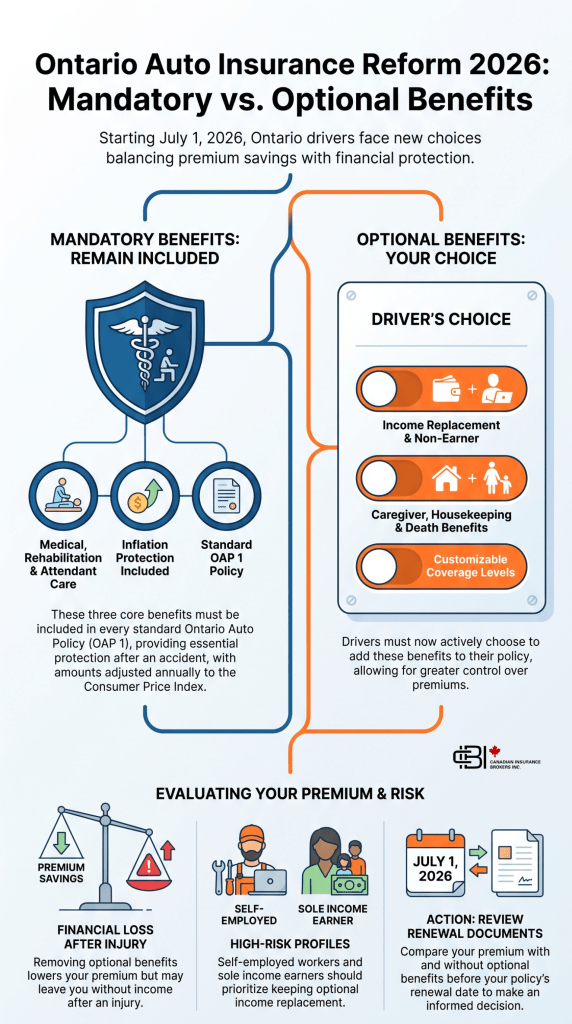
Ontario changed its auto insurance system on July 1, 2026. The most important updates affect Statutory Accident Benefits under the Ontario Automobile Policy, also known as the OAP 1.
Some benefits that were previously included in standard coverage are now optional. Drivers may have more control over their premium, but they also need to understand what they could lose by removing coverage.
At a Glance: Ontario’s 2026 Accident Benefits Changes
- The changes took effect on July 1, 2026
- Medical benefits remain mandatory
- Rehabilitation benefits remain mandatory
- Attendant care benefits remain mandatory
- Several other accident benefits are now optional
- Removing optional benefits may lower part of your premium
- Lower coverage could mean less financial support after an accident
- Existing policyholders should review their selections before renewal

What Are Statutory Accident Benefits?
Statutory Accident Benefits can provide financial support if you are injured in a vehicle accident. They may be available even when you caused the collision. These benefits can help pay for treatment and recovery. Depending on the coverage selected, they may also replace part of your income or provide support for your family.
Accident benefits are separate from:
- Coverage for damage to your vehicle
- Third-party liability coverage
- Direct Compensation Property Damage
- Uninsured automobile coverage
- Optional collision and comprehensive coverage
The 2026 reform mainly changes how accident benefits are selected. It does not remove the other mandatory sections of Ontario auto insurance.
What Changed on July 1, 2026?
Before the reform, Ontario policies automatically included several accident benefits. Drivers could purchase higher limits, but the standard policy provided a wider base of benefits.
The Financial Services Regulatory Authority of Ontario confirms that medical, rehabilitation and attendant care remain mandatory. Other accident benefits became optional as of July 2026.
Did you know? Ontario’s auto insurance system requires insurers to provide mandatory medical, rehabilitation and attendant care benefits to eligible injured persons. Benefit amounts are also indexed annually using Statistics Canada’s Consumer Price Index (CPI) to help keep pace with inflation.
Mandatory Accident Benefits
- Medical benefits
- Rehabilitation benefits
- Attendant care benefits
Optional Accident Benefits
- Income replacement
- Non-earner benefits
- Caregiver benefits
- Housekeeping and home maintenance
- Death benefits
- Funeral benefits
How Will Ontario’s 2026 Auto Insurance Reform Affect My Premium?
Your premium could decrease if you choose fewer optional accident benefits. However, there is no fixed discount that applies to every Ontario driver.
The amount depends on:
- The benefits you select
- The limits you choose
- Your insurance company
- Your driving record
- Your claims history
- Your vehicle
- Your postal code
- Annual kilometres
- Other policy coverages
Removing optional benefits affects only one part of your auto insurance price. Your overall premium could still increase because of a rate change or another rating factor. For example, a driver could remove income replacement coverage and receive a small reduction. The same driver could still see a higher renewal price because of rising repair costs or an approved insurer rate change.
Did you know? According to FSRA’s mid-year 2025 actuarial benchmarks, the projected future loss trend for Ontario’s medical, rehabilitation and attendant care accident benefits ranges from 0.4% to 4.0%, while disability income accident benefits have a projected trend of -4.9% to -1.5%. These trends are among the factors insurers consider when pricing auto insurance, alongside your driving record, vehicle, location and selected coverages.
How Much Could I Save by Removing Accident Benefits?
There is no standard dollar amount that applies across Ontario. Savings can vary because each insurer prices accident benefits differently. The price may also depend on the coverage limit selected.
Before removing a benefit, ask your broker for two prices:
- Your premium with the benefit
- Your premium without the benefit
You can then compare the annual savings with the amount of financial protection you would lose.
Saving a small amount each month may not be worthwhile if the removed benefit would have replaced income or supported your family after a serious injury.
What Does Income Replacement Coverage Do?
Income replacement benefits can provide financial support if accident-related injuries prevent you from working.
This coverage may be important for:
- Self-employed workers
- Contractors
- Commission-based employees
- Sole income earners
- Workers without disability insurance
- People with limited paid sick leave
Workplace disability coverage may reduce your need for income replacement benefits. However, employer plans can contain limits or waiting periods.
Review your workplace plan before making a decision. Confirm:
- How much of your income is covered
- How long benefits can continue
- Whether benefits apply to vehicle accidents
- When payments begin
- Whether bonuses or commissions are included
Who Should Consider Keeping Optional Benefits?
Optional benefits may be worth considering when an accident could place pressure on your household finances.
You may want more protection if you:
- Support children or other dependants
- Have a mortgage or large monthly expenses
- Work for yourself
- Have limited savings
- Do not have disability insurance
- Provide unpaid care to a family member
- Perform most household responsibilities
- Want additional support for your family after a fatal accident
Your age alone should not determine your selection. Your income and family responsibilities may be more important.
When Could Fewer Benefits Make Sense?
Some drivers may already have strong protection from another source.
Examples include:
- A workplace disability plan
- Extended health insurance
- Life insurance
- A workplace pension
- Significant emergency savings
- A spouse with dependable income
This does not automatically mean the optional benefits are unnecessary. Other plans may pay different amounts or contain exclusions.
Questions to Ask Before Changing Coverage
What would I save?
Ask for the exact annual premium difference before changing your coverage.
What would I lose?
Review the benefit amount and the situations in which it could apply.
What other coverage exists?
Check your workplace plans, disability insurance, savings and life insurance.
Who depends on me?
Consider children, a spouse, older parents or anyone who relies on your income.
Could I manage time off?
Think about mortgage payments, rent, bills and other costs during recovery.
Can I change it later?
Ask how coverage changes work during the policy term and at renewal.
What Does the New OAP 1 Wording Mean?
The OAP 1 is the standard owner’s automobile policy used in Ontario.
The policy wording explains:
- Who is insured
- Which vehicles are covered
- Mandatory insurance protection
- Optional coverage
- Claims responsibilities
- Exclusions
- Conditions of coverage
The new OAP 1 wording reflects the accident benefits choices available after July 1, 2026. The policy wording is important, but most drivers will first notice the changes on their renewal documents.
How to Read Your OAP 1 Declarations Page
The declarations page is a summary of your personal auto insurance policy. It is usually easier to read than the complete policy wording.
Check the declarations page for:
- Your name and address
- Policy number
- Policy term
- Listed drivers
- Insured vehicles
- Liability limit
- Deductibles
- Accident benefit selections
- Optional endorsements
- Total premium
Do not assume a benefit is included because it appeared on an older policy.
Look for a section describing accident benefits. Ask your broker to explain any wording you do not understand.
OAP 1 Renewal Guide for Ontario Drivers
Your renewal should be reviewed before the policy start date.
Follow these steps:
- Read the renewal package.
- Check your accident benefit selections.
- Confirm all drivers are listed correctly.
- Review how each vehicle is used.
- Check your liability limit.
- Review deductibles.
- Confirm optional endorsements.
- Compare prices with and without optional benefits.
- Ask what changed from the previous term.
- Keep a copy of your selections.
Existing policyholders may want to review or adjust their benefit selections before renewal. FSRA has instructed insurers and intermediaries to communicate the reform clearly and fairly.
Case Study: Auto Insurance Reform
On July 1, 2026, Ontario introduced significant changes to its auto insurance system, making several Statutory Accident Benefits optional for the first time. The reform was designed to give drivers more choice over their coverage and potentially lower their premiums. However, consumer advocates noted that drivers who remove optional benefits without fully understanding their policy could have less financial support following a serious accident.
The changes received widespread public attention across Ontario. As reported by CBC News coverage of Ontario’s 2026 auto insurance reform, many drivers are being encouraged to review their renewal documents carefully before deciding whether to keep or remove optional accident benefits.
Get a quote with James Inwood to review your Ontario auto insurance policy and understand how the 2026 accident benefits changes may affect your coverage and premium before your next renewal.
How the Changes May Affect Oakville Drivers
Drivers across Oakville may have different coverage needs depending on where they live, work and commute.
- Downtown Oakville: Drivers may deal with busy intersections, pedestrian traffic and frequent short trips near shops and restaurants.
- Kerr Village: Narrow streets, street parking and mixed residential and commercial traffic can create different driving conditions.
- Glen Abbey: Families with multiple vehicles, young drivers and regular highway commutes may want to review how optional benefits apply to everyone on the policy.
- West Oakville: Contractors, tradespeople and self-employed drivers may rely heavily on their income and should review income replacement options carefully.
- Trafalgar area: Daily travel toward the QEW, Highway 407 and nearby business districts may mean more time spent commuting.
- Bronte Village: Waterfront traffic, seasonal visitors and busy roads around Lakeshore Road West can increase local driving activity.
The neighbourhood where you live does not decide which accident benefits you need. Your income, family responsibilities, workplace coverage and ability to manage time away from work are more important when reviewing your policy.
Road Safety Snapshot: Preliminary Ontario data for 2024 recorded 617 road fatalities, including 107 pedestrian fatalities and 155 fatalities in speed-related collisions. While most trips end safely, the figures highlight why reviewing your insurance coverage before removing optional protections is important.
Why Work With James Inwood
Choosing accident benefits is not just about lowering your auto insurance premium. It involves understanding your income, workplace benefits, family responsibilities, medical coverage and the financial impact of being unable to work after an accident.
James Inwood works with drivers across Ontario to help review OAP 1 coverage and accident benefit options under the 2026 auto insurance reform. Whether you are self-employed, supporting a family or reviewing a renewal in Oakville, the goal is to help you understand your options and choose coverage that fits your needs.
Get a quote or book a meeting with James Inwood to review your Ontario auto insurance and accident benefit options.
Frequently Asked Questions
Ontario motorcycle policies can include Statutory Accident Benefits. Riders should ask their insurer or broker how the new options apply to their specific policy and renewal.
Accident benefits selections are generally made at the policy level. Ask your broker how the selected benefits apply to each insured person and listed driver.
No. Choosing fewer optional accident benefits does not create a conviction or change your driving record. It changes the protection available under the policy.
Passengers injured in an accident may still have access to accident benefits. The correct insurer and application process depend on the circumstances of the accident.
No. Accident benefits and third-party liability are different sections of an Ontario auto policy. Increasing accident benefits does not automatically change your liability coverage.

James Inwood is an Ontario-based insurance broker who works with drivers across Oakville and the province to review personal auto insurance coverage. He helps clients understand Ontario Automobile Policy changes, Statutory Accident Benefits, optional coverage selections, renewal documents, deductibles, liability limits, and how policy decisions may affect their protection after an accident.
James Inwood, Insurance Broker
RIBO licensed | LinkedIn