
How to Write a Business Plan in Oakville & Halton Region
We provide professional insurance guidance for businesses and individuals through a secure and confidential quote process designed to be clear, efficient, and easy to begin.
Locally established in Oakville, Ontario

Coverage designed to match your business needs

Insurance options reviewed across markets and emailed to you

How to Write a Business Plan in Oakville & Halton Region

We provide professional insurance guidance for businesses and individuals through a secure and confidential quote process designed to be clear, efficient, and easy to begin.

Locally established in Oakville, Ontario

Coverage designed to match your business needs
Insurance options reviewed across markets and emailed to you
Starting a business in Ontario takes more than a promising idea. You need a practical plan explaining how the company will attract customers, generate revenue, manage expenses, meet legal requirements, and respond to unexpected losses.
A clear Ontario business plan helps you test whether the idea is financially realistic before you invest heavily. It may also support applications for financing, commercial leases, grants, partnerships, or private investment.
At a Glance: Writing an Ontario Business Plan
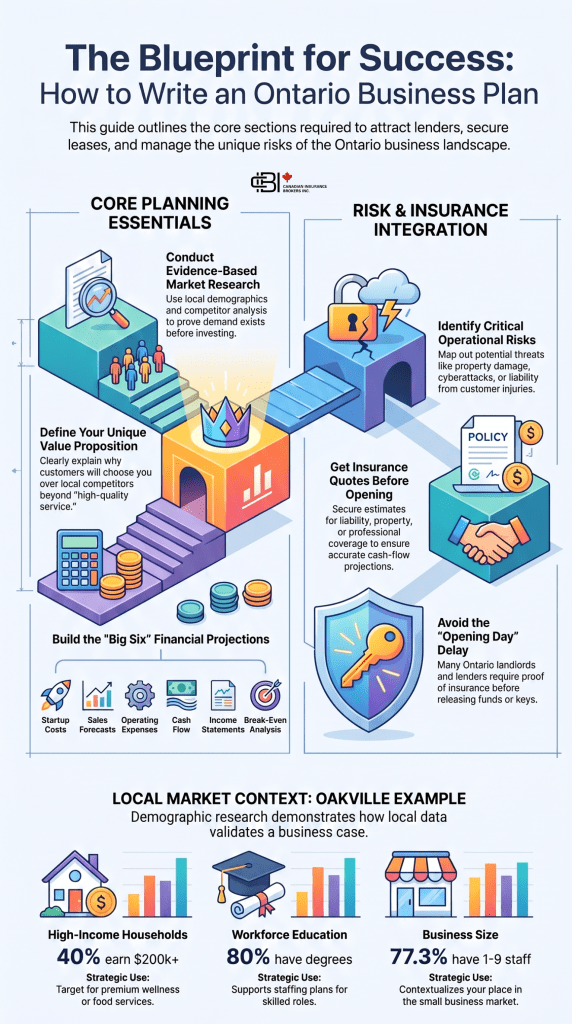
- Explain what the business sells and who it serves.
- Research the Ontario market and local competitors.
- Estimate realistic startup and operating costs.
- Include commercial insurance in your startup budget.
- Identify permits, licences, leases, and contractual requirements.
- Prepare cash-flow and financial projections.
- Explain how business risks will be managed.
- State how much financing is needed and how it will be used.
- Update the plan as the business changes.

What Is an Ontario Business Plan?
A business plan is a written document describing your business, its objectives, target market, operating strategy, and financial forecast. It helps establish realistic goals and support requests for external financing.
Depending on your goals, the plan may be used to:
- Apply for a business loan
- Approach investors
- Lease commercial space
- Apply for grants or startup programs
- Explain the business to suppliers or partners
- Plan staffing and equipment purchases
- Estimate commercial insurance costs
- Guide decisions during the first years of operation
The strongest plans are based on evidence and documented assumptions rather than broad claims.
Who Should Write a Business Plan?
Almost every new company can benefit from a written plan. Examples include:
- Contractors
- Restaurants
- Food trucks
- Dog walkers
- Retail stores
- Professional service firms
- Manufacturers
- Online businesses
- Home-based businesses
- Wellness clinics
- Technology companies
- Consultants
- Franchise operators
Existing companies may also prepare a new plan before expanding, purchasing equipment, hiring employees, entering a new market, or seeking financing.
Why Is a Business Plan Important in Ontario?
Writing a business plan requires you to investigate whether the business can operate successfully. It helps you:
- Define your business goals.
- Identify your target customers.
- Research competitors.
- Estimate startup costs.
- Forecast revenue and expenses.
- Plan staffing and operations.
- Identify legal and insurance requirements.
- Prepare for growth.
- Explain your business to lenders or investors.
Why Should Insurance Be Included in Your Business Plan?
New entrepreneurs often budget for rent, equipment, inventory, wages, and marketing but leave insurance until the final days before opening.
That can create problems if a landlord, lender, municipality, client, or event organizer requires proof of insurance before the business can operate. Including insurance in the plan helps you:
- Estimate startup costs more accurately.
- Include premiums in monthly cash-flow projections.
- Prepare for landlord or lender requirements.
- Meet contract requirements before starting work.
- Protect equipment, inventory, and other assets.
- Plan for liability claims or business interruptions.
- Avoid delays close to the opening date.
Did You Know? Small businesses remain the dominant business type in Canada. Innovation, Science and Economic Development Canada reports that micro-enterprises with one to four employees represent 59.1% of Canadian employer businesses, while businesses with one to nine employees represent 77.3%.
What Should an Ontario Business Plan Include?
Most Ontario business plans contain similar core sections:
- Executive Summary
- Business Description
- Products or Services
- Target Market
- Competitor Analysis
- Marketing and Sales Strategy
- Operations Plan
- Management Team
- Risk and Insurance Plan
- Financial Projections
- Funding Requirements
- Supporting Documents
Each section should answer a practical question about how the company will operate.
What Should Be Included in the Risk and Insurance Section?
The risk section should identify events that could prevent the company from meeting its goals. Examples include:
- Customer injuries
- Professional errors
- Property damage
- Equipment theft
- Vehicle collisions
- Cyberattacks
- Supply interruptions
- Employee injuries
- Fire or water damage
- A temporary shutdown
For each major risk, explain how it will be reduced.
Risk controls may include:
- Staff training
- Written contracts
- Safety procedures
- Data backups
- Equipment maintenance
- Emergency plans
- Commercial insurance
You do not need to include full policy wording in the business plan. A short summary of the expected coverage, estimated premium, and reason it is needed is usually more useful.
Is Your Ontario Business Plan Ready?
A strong plan should give lenders and investors clear answers without forcing them to search through the document.
Does the plan clearly explain the problem your business solves?
Have you identified who will buy your products or services?
Does the plan explain who your competitors are and how you differ?
Is it clear why customers would choose your business?
Does the plan show how the business will generate income?
Have you included equipment, inventory, permits, rent and insurance?
Have you identified operational risks and the insurance required?
Does the plan state how much financing you need?
Have you explained exactly how borrowed or invested money will be used?
Are insurance, cash flow, revenue and expense projections realistic?
Someone unfamiliar with your company should understand what you sell, who you serve, how you make money, what could disrupt operations and how those risks will be managed.
What Should You Do Before You Start Writing?
Gather the key information before opening a blank document.
Prepare:
- Business name and ownership structure
- Products or services
- Target customers
- Competitor research
- Startup budget
- Revenue assumptions
- Pricing strategy
- Marketing plan
- Operating expenses
- Licensing requirements
- Lease or contract requirements
- Preliminary insurance quotes
If you’re not sure where to begin, reviewing sample business plans and planning templates can make the writing process much easier.
Which Insurance Quotes Should You Get Before Launch?
The coverage depends on your operations, but you may need estimates for:
- Commercial general liability
- Commercial property
- Professional liability
- Commercial auto
- Cyber insurance
- Equipment breakdown
- Business interruption
- Tools and equipment
- Product liability
- Crime coverage
Get a quote before finalizing your business plan and financial projections.
How Do You Write a Business Description?
Your business description explains what your company does, who it serves, and how it operates. It should include:
- Business name
- Structure
- Products or services
- Target customers
- Business location
- Service area
- Short-term goals
- Long-term goals
Avoid writing only that you provide “high-quality service.” Instead, explain the value your business delivers and why customers would choose you over competitors.
For example: ABC Property Services provides residential and commercial landscaping throughout Halton Region. The company specializes in year-round maintenance contracts, snow removal, and landscape construction for homeowners, condominium corporations, and small businesses.
A clear business description helps lenders, investors, suppliers, and insurance providers better understand your operations.
Why Does Your Business Model Affect Your Insurance?
The way your business operates can influence the insurance you may need. A home-based consultant faces different risks than a contractor with employees or a restaurant serving hundreds of customers each week. Examples include:
- Home-based businesses may need to disclose commercial activities to their home insurer.
- Contractors often require commercial general liability, tools coverage, and commercial auto insurance.
- Restaurants commonly need property insurance, equipment breakdown coverage, and business interruption insurance.
- Professional service businesses may benefit from professional liability and cyber insurance.
- Retail stores often require commercial property insurance, inventory coverage, and liability protection.
Understanding your operating model early makes it easier to estimate insurance costs and include them in your business plan.
How Do You Research Your Market?
Market research helps determine whether enough customers exist to support your business.
Start by identifying:
- Your target customers
- Where they live
- Their spending habits
- Their needs
- Your competitors
- Market size
- Industry trends
Useful sources include demographic reports, municipal economic development data, industry associations, competitor websites, customer surveys, and Statistics Canada.
Good market research answers three important questions:
- Is there demand?
- Can I reach those customers?
- Can the business make a profit?
Strong market research also improves your revenue forecasts because your financial projections are based on evidence instead of assumptions.
Can Market Research Affect Your Insurance?
Yes, your research can also reveal risks that affect the type of insurance your business may require. For example, your business plan may identify:
- Expensive equipment
- Company vehicles
- Multiple locations
- Mobile operations
- Customer visits
- Professional advice
- Online sales
- Employees
Each of these factors can influence your insurance requirements.
Reviewing operational risks during the planning stage helps avoid coverage gaps after the business opens.
How Should You Analyze Competitors?
A competitor analysis demonstrates that you understand your industry.
Review competitors by comparing:
- Products or services
- Pricing
- Customer reviews
- Location
- Marketing
- Strengths
- Weaknesses
Then explain why customers will choose your business instead.
Your competitive advantage might include:
- Faster response times
- Better customer service
- Specialized knowledge
- Mobile service
- Longer operating hours
- Premium products
- Local experience
Avoid claiming that you have “no competition.” Every business has alternatives that customers can choose.
Match Business Activities With the Right Protection
Insurance needs usually follow the way a business operates. The more clearly your plan describes those activities, the easier it is to identify the coverage that may be relevant.
Customers Visit Your Location
A customer could slip, fall, or allege that your business damaged their property.
You Give Professional Advice
A client may claim that an error, recommendation, or missed detail caused a financial loss.
You Own Equipment or Inventory
Fire, theft, water damage, or another covered loss could interrupt operations and create replacement costs.
You Use Vehicles for Work
Deliveries, service calls, tools, and employee driving can create commercial automobile exposure.
You Store Customer Data
Payment information, personal records, and online systems may be exposed to cyber incidents or privacy breaches.
A Loss Could Stop Operations
A covered property loss may prevent the business from earning revenue while expenses continue.
List the activities your company will perform, the property it will own, the people it will serve, and the events that could interrupt operations. Then include realistic insurance estimates in your startup budget and financial projections.
How Do You Create a Marketing Strategy?
A marketing plan explains how customers will discover your business.
Popular channels include:
- Google Search
- Social media
- Email marketing
- Networking
- Paid advertising
- Referral programs
- Community events
- Strategic partnerships
Your sales process should also be explained. For example: Customer Inquiry → Consultation → Quote → Deposit → Service → Final Payment → Follow-up
The number of customers expected from your marketing plan should support your revenue forecast.
How Do You Prepare Financial Projections?
Financial projections explain how your business is expected to perform financially. Most plans include:
- Startup costs
- Sales forecasts
- Operating expenses
- Cash flow
- Income statement
- Balance sheet
- Break-even analysis
Every figure should be supported by reasonable assumptions.
What Business Plan Mistakes Should You Avoid?
A business plan becomes less credible when its assumptions are unclear or its financial projections do not match the way the company will operate.
Common mistakes include:
- Overestimating sales without explaining how customers will be acquired
- Underestimating rent, wages, equipment, marketing, or insurance
- Claiming there is no competition
- Using outdated market research
- Ignoring licences, zoning, or contractual requirements
- Leaving insufficient working capital
- Failing to identify major operational risks
- Treating insurance as an expense to consider after opening
- Using the same plan for lenders, investors, and internal planning
- Including financial figures the owner cannot explain
A strong plan acknowledges uncertainty. It shows what the owner expects to happen, why those assumptions are reasonable, and how the business will respond if sales are slower or expenses are higher than expected.
Did you know? Most businesses in Oakville require a valid business licence before operating, with requirements depending on the type of business.
How Should You Plan for a Slower Start?
New companies do not always reach their expected sales immediately. Prepare a conservative scenario showing how the business would operate if:
- Opening is delayed
- Customer demand develops slowly
- Equipment costs increase
- A major client postpones a contract
- Seasonal demand is weaker than expected
- An insured or uninsured loss interrupts operations
Review how much working capital would remain and how long the business could continue paying rent, loan payments, payroll, insurance, and other fixed expenses.
What Happens When Insurance Is Missing From the Plan?
Leaving insurance out of a business plan can affect more than the budget. Possible consequences include:
- A commercial landlord refusing to release the premises
- A lender requiring coverage before funding equipment
- A client delaying a contract until a certificate of insurance is provided
- A municipality or event organizer refusing an application
- An unexpected premium changing the cash-flow forecast
- Business property being inadequately insured
- A personal policy not covering commercial activity
- A claim creating expenses the startup cannot absorb
The plan does not need to include complete policy wording. It should identify the main risks, expected insurance, estimated annual premium, and any coverage required by a lease, loan, licence, or contract.
Case Study: From an Oakville Startup to a Global Technology Company
Geotab began as a two-person Oakville startup and developed into a global telematics and connected-vehicle technology company. Oakville’s 2025 Economic Development Annual Report identifies Geotab as a prominent local business success and notes that its founder was recognized as The Globe and Mail’s 2025 CEO of the Year.
While its original business plan has not been made public, Geotab’s growth demonstrates why entrepreneurs should regularly update their business plan as operations, staffing, technology, financing, and insurance needs evolve.
A plan written for a two-person startup will not remain suitable as a company adds employees, customers, equipment, locations, or international operations. Business plans and commercial insurance should both be reviewed as the organization grows.
Oakville Business Planning Statistics
Oakville’s local data can strengthen the market-research section of a business plan, but the figures should be connected to the company’s actual target customer and operating model.
- Nearly 40% of Oakville households earn more than $200,000 annually. This may be relevant to businesses selling premium home, professional, wellness, food, or personal services, but it does not guarantee demand for a particular company.
- More than 80% of Oakville residents aged 25 to 64 have a post-secondary degree or certificate. Businesses requiring skilled employees can use this information when discussing local workforce availability.
- Oakville businesses have access to a labour pool of more than 3.9 million workers across the GTHA, including 2.1 million within a 40-minute drive. This can support staffing plans, but employers should still research wages, availability, and qualifications for each role.
- Oakville’s population exceeds 240,000, giving local businesses access to a substantial residential market while remaining connected to the wider Greater Toronto and Hamilton Area.
What Local Business Support Is Available in Oakville?
Oakville’s Economic Development team provides assistance with startup and growth resources, industry information, development approvals, and connections to local business-support organizations.
Entrepreneurs can also access:
- Startup resources
- Funding databases
- Networking opportunities
- Industry and workforce data
- Coworking information
- Business Improvement Area resources
- Municipal zoning and development information
These resources can strengthen a plan, but the owner should still understand every assumption, forecast, and risk described in the document.
Insurance Tips Before Opening an Ontario Business
Before signing a lease, purchasing equipment, or accepting customer work:
- Describe all business activities accurately.
- Confirm whether clients will visit your home or premises.
- Disclose professional advice, installation, delivery, or mobile services.
- Identify business vehicles and regular drivers.
- Calculate the replacement value of equipment and inventory.
- Review lease and financing insurance clauses.
- Ask clients about minimum liability limits.
- Include insurance premiums in your cash-flow forecast.
- Confirm when coverage must begin.
- Review the policy whenever operations change.
Do not wait until opening day to request a quote. Some businesses require additional underwriting information, inspections, contracts, or specialized insurance markets.
Why Work With James Inwood
A realistic business plan should include the cost of protecting the company. James Inwood works with Ontario entrepreneurs to review commercial insurance options based on their operations, property, equipment, vehicles, employees, contracts, and expected growth.
Getting an insurance estimate before launch can help you prepare more accurate startup costs and financial projections.
Get a quote or book a meeting with James Inwood to review the insurance needs in your business plan.

Frequently Asked Questions
There is no required length. A straightforward small-business plan may be shorter than a plan prepared for a major loan or outside investment. Include enough information to explain the market, operations, management, risks, and finances without adding unnecessary material.
A business plan is not universally required to register a company. However, a lender, investor, landlord, grant program, or business partner may request one. It is also useful for testing whether the idea is operationally and financially realistic.
Yes. Include expected insurance premiums in startup costs and ongoing expenses. The risk section should also identify the main types of coverage that may be needed.
Request an estimate while preparing the startup budget and before signing contracts or opening. Update the quote when the business address, revenue, services, equipment, employees, or vehicles become clearer.
Many plans include a startup budget, sales forecast, expense forecast, cash-flow projection, projected income statement, balance sheet, and break-even analysis. The lender or investor

James Inwood is an Ontario-based insurance broker who works with entrepreneurs, contractors, retailers, restaurants, professional service firms, manufacturers, and other small businesses. He helps clients review commercial liability, property, professional liability, cyber, commercial auto, equipment, and business interruption insurance based on how the company plans to operate.
James Inwood, Insurance Broker
RIBO licensed | LinkedIn